
Ch.6 - Alkyl Halides; Nucleophilic Substitution
Wade - Organic Chemistry 9th Edition
Wade9th EditionOrganic ChemistryISBN: 9780135213728당신이 사용하는 게 아니라요?교과서 변경
6장, 문제 6b

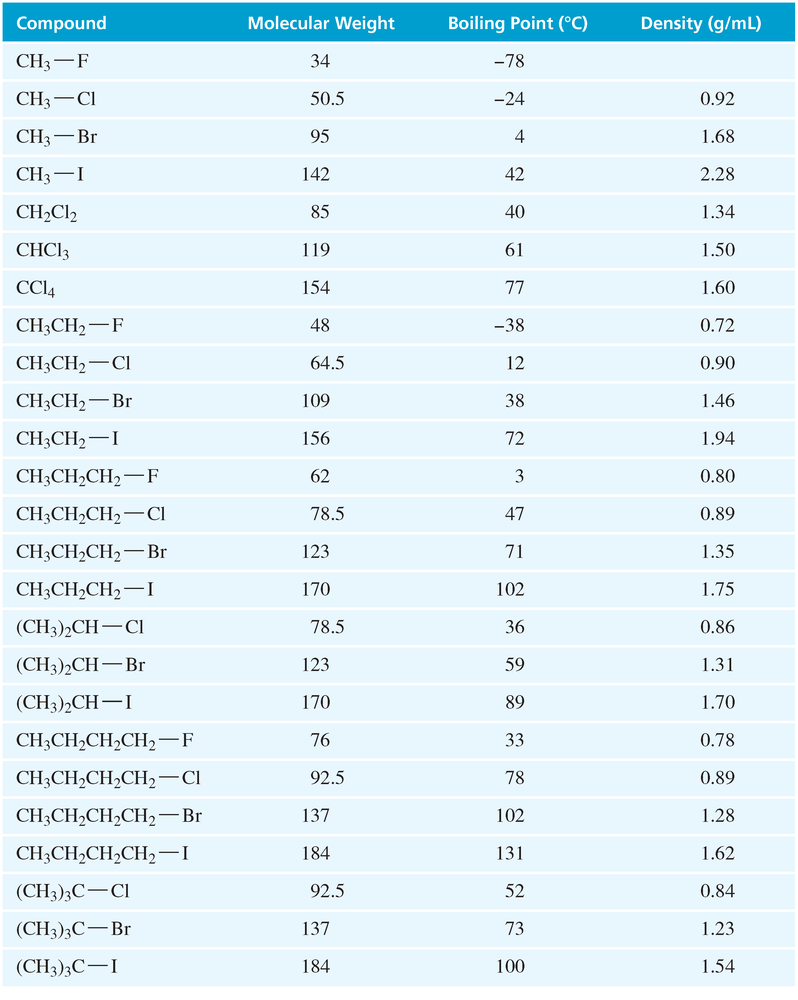
For each pair of compounds, predict which compound has the higher boiling point. Check [TABLE 6-2] to see if your prediction was right; then explain why that compound has the higher boiling point.
b. isopropyl chloride and tert-butyl bromide

검증된 단계별 안내
1
Identify the functional groups and molecular structures of each compound. Isopropyl chloride is an alkyl halide with a chlorine atom attached to an isopropyl group, while tert-butyl bromide is an alkyl halide with a bromine atom attached to a tert-butyl group.
Consider the molecular weight of each compound. Bromine is heavier than chlorine, which generally contributes to a higher boiling point due to increased van der Waals forces.
Evaluate the branching in the carbon chain. Tert-butyl bromide has more branching compared to isopropyl chloride, which can affect boiling point by reducing surface area and intermolecular forces.
Analyze the electronegativity and polarizability of the halogens. Bromine is less electronegative but more polarizable than chlorine, which can lead to stronger intermolecular forces and a higher boiling point.
Compare the intermolecular forces present in each compound. Consider dipole-dipole interactions and van der Waals forces, which are influenced by the size and polarizability of the halogen atoms.

비슷한 문제에 대한 검증된 영상 답변:

이 영상 해법은 위 문제에 도움이 된다고 튜터들이 추천한 것입니다.
영상 길이:
2m
도움이 되었나요?

주요 개념

질문에 올바르게 답하기 위해 반드시 이해해야 하는 핵심 개념들은 다음과 같습니다.

Intermolecular Forces

Intermolecular forces are the forces that hold molecules together, affecting properties like boiling points. The stronger the intermolecular forces, such as hydrogen bonding, dipole-dipole interactions, and van der Waals forces, the higher the boiling point. In this context, understanding the type and strength of these forces in isopropyl chloride and tert-butyl bromide is crucial.
추천 영상:
03:01
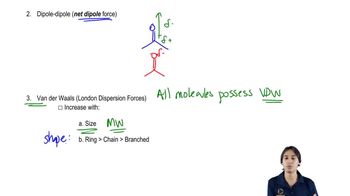
How Van der Waals forces work.

Molecular Structure and Polarity

The molecular structure and polarity of a compound influence its boiling point. Polar molecules, which have uneven distribution of electron density, typically exhibit stronger dipole-dipole interactions, leading to higher boiling points. Analyzing the structure of isopropyl chloride and tert-butyl bromide helps determine their polarity and predict boiling points.
추천 영상:
2:04
Molecular Polarity

Halogen Influence on Boiling Point

Halogens, such as chlorine and bromine, impact boiling points due to their size and electronegativity. Bromine, being larger and less electronegative than chlorine, can lead to stronger van der Waals forces in tert-butyl bromide compared to isopropyl chloride. This concept helps explain why tert-butyl bromide might have a higher boiling point.
추천 영상:
03:08
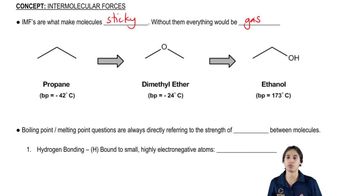
How IMFs are related to melting and boiling points.