Ch.6 - Alkyl Halides; Nucleophilic Substitution
Wade - Organic Chemistry 9th Edition
Wade9th EditionOrganic ChemistryISBN: 9780135213728당신이 사용하는 게 아니라요?교과서 변경
6장, 문제 26b

Propose a mechanism involving a hydride shift or an alkyl shift for each solvolysis reaction. Explain how each rearrangement forms a more stable intermediate.
Hint: Most rearrangements convert 2° (or incipient 1°) carbocations to 3° or resonance-stabilized carbocations.
(b)

검증된 단계별 안내
1
Step 1: Identify the leaving group in the starting material. In this case, the chlorine atom (Cl) is the leaving group. Under solvolysis conditions with CH3CH2OH and heat, the Cl will leave, forming a carbocation intermediate.
Step 2: Analyze the stability of the carbocation formed after the leaving group departs. The initial carbocation is a secondary carbocation (2°), which is less stable than a tertiary carbocation (3°). This instability drives the rearrangement.
Step 3: Propose a hydride shift or alkyl shift to stabilize the carbocation. In this case, a hydride shift occurs where a hydrogen atom (along with its bonding electrons) from the adjacent carbon migrates to the carbocation center. This results in the formation of a tertiary carbocation (3°), which is more stable due to increased hyperconjugation and inductive effects.
Step 4: Once the tertiary carbocation is formed, the nucleophile (CH3CH2OH) attacks the carbocation. The oxygen atom in ethanol donates a pair of electrons to form a bond with the carbocation, resulting in the formation of an ether product.
Step 5: Repeat the process for any alternative rearrangements that could lead to other products. In this case, the hydride shift leads to two possible tertiary carbocations, each of which reacts with ethanol to form the two observed ether products.

비슷한 문제에 대한 검증된 영상 답변:

이 영상 해법은 위 문제에 도움이 된다고 튜터들이 추천한 것입니다.
영상 길이:
10m
도움이 되었나요?

주요 개념

질문에 올바르게 답하기 위해 반드시 이해해야 하는 핵심 개념들은 다음과 같습니다.

Carbocation Stability

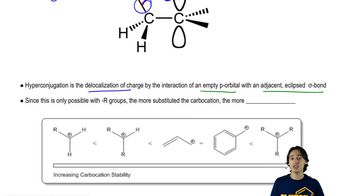
Carbocations are positively charged carbon species that can rearrange to form more stable intermediates. Stability increases from primary to tertiary carbocations due to hyperconjugation and inductive effects. In solvolysis reactions, a hydride or alkyl shift can convert a less stable carbocation (like a secondary) into a more stable tertiary or resonance-stabilized carbocation, facilitating the reaction.
추천 영상:
05:58
Determining Carbocation Stability

Rearrangement Mechanisms

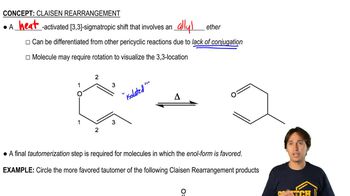
Rearrangement mechanisms, such as hydride shifts and alkyl shifts, involve the migration of hydrogen or alkyl groups to adjacent carbocations. These shifts occur to stabilize the carbocation by forming a more stable structure. Understanding these mechanisms is crucial for predicting the products of solvolysis reactions, as they dictate the pathway and stability of intermediates formed during the reaction.
추천 영상:
06:08
Definition of Claisen Rearrangement

Solvolysis Reactions

Solvolysis reactions involve the substitution of a leaving group (like Cl) by a nucleophile (like an alcohol) in the presence of a solvent. The reaction typically proceeds through the formation of a carbocation intermediate, which can undergo rearrangement to enhance stability. The solvent can also stabilize the carbocation, influencing the reaction's rate and product distribution, making it essential to consider solvent effects in these reactions.
추천 영상:
05:09
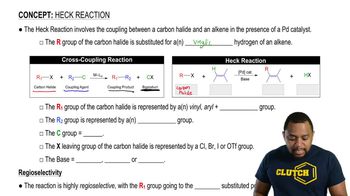
Heck Reaction