

Ch.6 - Alkyl Halides; Nucleophilic Substitution
Wade - Organic Chemistry 9th Edition
Wade9th EditionOrganic ChemistryISBN: 9780135213728당신이 사용하는 게 아니라요?교과서 변경
6장, 문제 6a,b,c

Under appropriate conditions, (S)-1-bromo-1-fluoroethane reacts with sodium methoxide to give pure (S)-1-fluoro-1-methoxyethane.

a. Why is bromide rather than fluoride replaced?
b. Draw perspective structures (as shown on the previous page for 2-bromobutane) for the starting material, the transition state, and the product.
c. Does the product show retention or inversion of configuration? d. Is this result consistent with reaction by the SN2 mechanism?

검증된 단계별 안내
1
Step 1: Analyze part (a) of the problem. Bromide is replaced rather than fluoride because bromide is a better leaving group. Leaving group ability is determined by the stability of the group after it departs. Bromide (Br⁻) is larger and more polarizable than fluoride (F⁻), making it more stable as an ion and thus a better leaving group.
Step 2: For part (b), draw perspective structures for the starting material, transition state, and product. The starting material (S)-1-bromo-1-fluoroethane should be drawn with the bromine atom on a wedge (coming out of the plane) and the fluorine atom on a dash (going into the plane). The transition state will show partial bonds between the carbon and the bromine (breaking bond) and the carbon and the methoxide (forming bond). The product (S)-1-fluoro-1-methoxyethane should retain the stereochemistry, with the methoxy group on a wedge and the fluorine on a dash.
Step 3: Address part (c). The product shows retention of configuration. In an SN2 reaction, the nucleophile attacks from the opposite side of the leaving group, causing inversion of configuration. However, in this case, the stereochemistry is retained because the reaction involves a second inversion during the process, leading to overall retention.
Step 4: For part (d), evaluate whether the result is consistent with the SN2 mechanism. Yes, the result is consistent with the SN2 mechanism. The reaction proceeds via a single-step bimolecular process where the nucleophile attacks the electrophilic carbon, displacing the leaving group. The retention of configuration is explained by the double inversion mechanism, which is characteristic of certain SN2 reactions.
Step 5: Summarize the key concepts. Bromide is replaced due to its superior leaving group ability. The stereochemistry of the product is retained due to a double inversion mechanism. The reaction mechanism aligns with the principles of SN2, which involve a concerted attack by the nucleophile and displacement of the leaving group.

비슷한 문제에 대한 검증된 영상 답변:

이 영상 해법은 위 문제에 도움이 된다고 튜터들이 추천한 것입니다.
영상 길이:
12m

주요 개념

질문에 올바르게 답하기 위해 반드시 이해해야 하는 핵심 개념들은 다음과 같습니다.

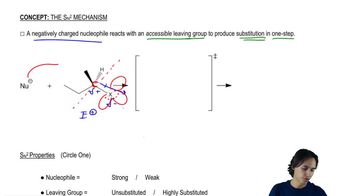
SN2 Mechanism

The SN2 mechanism is a type of nucleophilic substitution reaction where a nucleophile attacks an electrophile, resulting in the simultaneous displacement of a leaving group. This reaction occurs in a single concerted step, leading to inversion of configuration at the chiral center. The rate of the reaction depends on the concentration of both the nucleophile and the substrate, making it a bimolecular process.
추천 영상:
08:33
Drawing the SN2 Mechanism

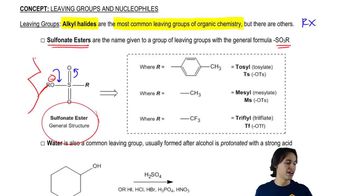
Leaving Groups

In organic chemistry, a leaving group is an atom or group that can depart with a pair of electrons in a substitution or elimination reaction. The ability of a leaving group to stabilize the negative charge after departure is crucial; good leaving groups, like bromide, are typically weak bases. In this reaction, bromide is favored over fluoride due to its better leaving group ability, facilitating the SN2 process.
추천 영상:
07:22
The 3 important leaving groups to know.

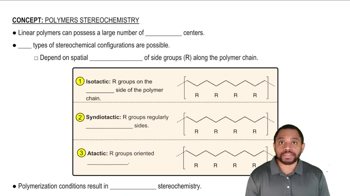
Stereochemistry

Stereochemistry refers to the study of the spatial arrangement of atoms in molecules and how this affects their chemical behavior. In the context of this reaction, understanding whether the product retains or inverts configuration is essential. The stereochemical outcome is determined by the mechanism of the reaction; SN2 reactions typically result in inversion of configuration due to the backside attack of the nucleophile.
추천 영상:
가이드 코스
1:38
Polymer Stereochemistry Concept 1
관련 실천
교과서 질문

a. Propose a mechanism for the following reaction:

b. Use the bond-dissociation enthalpies given in Table 4-2 (page 167) to calculate the value of ΔH° for each step shown in your mechanism. (The BDE for CH2=CHCH2―Br is about 280 kJ/mol, or 67 kcal/mol.) Calculate the overall value of ΔH° for the reaction. Are these values consistent with a rapid free-radical chain reaction?

2163
views
교과서 질문

Show how you might use SN2 reactions to convert 1-chlorobutane into the following compounds.

a. butan-1-ol

930
views
교과서 질문
The reaction of an amine with an alkyl halide gives an ammonium salt. R3N amine + R'—X alkyl halide —> R3(N+)—R' X- ammonium salt The rate of this SN2 reaction is sensitive to the polarity of the solvent. 1. Draw an energy diagram for this reaction in a nonpolar solvent and another in a polar solvent. 2. Consider the nature of the transition state, and explain why this reaction should be sensitive to the polarity of the solvent. 3. Predict whether it will be faster or slower in a more polar solvent.

2761
views
교과서 질문
The reaction of an amine with an alkyl halide gives an ammonium salt. R3N amine + R'—X alkyl halide —> R3(N+)—R' X- ammonium salt The rate of this SN2 reaction is sensitive to the polarity of the solvent. 1. Draw an energy diagram for this reaction in a nonpolar solvent and another in a polar solvent. 2. Consider the nature of the transition state, and explain why this reaction should be sensitive to the polarity of the solvent. 3. Predict whether it will be faster or slower in a more polar solvent.
523
views
교과서 질문

Show how you might use SN2 reactions to convert 1-chlorobutane into the following compounds.

b. 1-fluorobutane

675
views
교과서 질문

For each pair of compounds, predict which compound has the higher boiling point. Check [TABLE 6-2] to see if your prediction was right; then explain why that compound has the higher boiling point.

a. isopropyl bromide and n-butyl bromide

1435
views