Ch 04: Kinematics in Two Dimensions
Knight Calc - Physics for Scientists and Engineers 5th Edition
Knight Calc5th EditionPhysics for Scientists and EngineersISBN: 9780137344796당신이 사용하는 게 아니라요?교과서 변경
4장, 문제 8a

A particle moving in the xy-plane has velocity v = (2ti + (3-t2)j) m/s, where t is in s. What is the particle's acceleration vector at t = 4s?

검증된 단계별 안내
1
Step 1: Recall that acceleration is the time derivative of velocity. To find the acceleration vector, differentiate the given velocity vector v = (2t i + (3 - t^2) j) m/s with respect to time t.
Step 2: Differentiate the x-component of the velocity, 2t, with respect to t. The derivative of 2t is 2, so the x-component of acceleration is 2 i m/s².
Step 3: Differentiate the y-component of the velocity, (3 - t^2), with respect to t. The derivative of 3 is 0, and the derivative of -t^2 is -2t. Thus, the y-component of acceleration is -2t j m/s².
Step 4: Combine the x- and y-components to express the acceleration vector as a = (2 i - 2t j) m/s².
Step 5: Substitute t = 4s into the acceleration vector expression to find the specific acceleration vector at t = 4s. This gives a = (2 i - 2(4) j) m/s².

비슷한 문제에 대한 검증된 영상 답변:

이 영상 해법은 위 문제에 도움이 된다고 튜터들이 추천한 것입니다.
영상 길이:
3m

주요 개념

질문에 올바르게 답하기 위해 반드시 이해해야 하는 핵심 개념들은 다음과 같습니다.

Velocity

Velocity is a vector quantity that describes the rate of change of an object's position with respect to time. It has both magnitude and direction, and in this case, it is given as a function of time in the xy-plane. Understanding velocity is crucial for determining how the position of the particle changes over time.
추천 영상:
가이드 코스
7:27
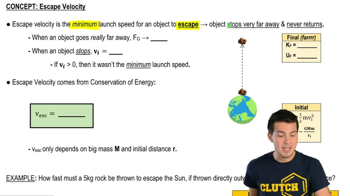
Escape Velocity

Acceleration

Acceleration is the rate of change of velocity with respect to time. It is also a vector quantity, indicating both how quickly the velocity of an object is changing and in which direction. To find the acceleration vector, one must differentiate the velocity vector with respect to time.
추천 영상:
가이드 코스
05:47
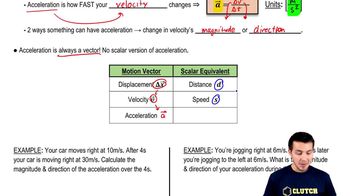
Intro to Acceleration

Differentiation

Differentiation is a fundamental concept in calculus that involves finding the derivative of a function. In physics, it is used to determine rates of change, such as how velocity changes over time to yield acceleration. For the given velocity function, applying differentiation will provide the acceleration vector at any specified time.
추천 영상:
가이드 코스
13:04
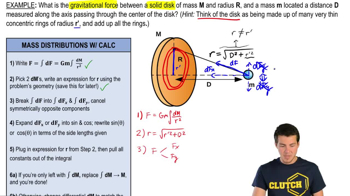
Gravitational Force from a Solid Disk
관련 실천
교과서 질문

You have a remote-controlled car that has been programmed to have velocity v=(3ti+2t2j)m/s\(\mathbf{v}\) = (-3t\(\mathbf{i}\) + 2t^2\(\mathbf{j}\)) \, \(\text{m/s}\), where t is in s. At t = 0 s, the car is at r0=(3.0i+2.0j)m\(\mathbf{r}\)_0 = (3.0\(\mathbf{i}\) + 2.0\(\mathbf{j}\)) \, \(\text{m}\). What are the car's position vector?

1941
views

교과서 질문

A particle's trajectory is described by x=(12t32t2)mandy=(12t22t)m,x = \(\left\)(\(\frac{1}{2}\) t^3 - 2t^2\(\right\)) \, \(\text{m}\) \(\quad\) \(\text{and}\) \(\quad\) y = \(\left\)(\(\frac{1}{2}\) t^2 - 2t\(\right\)) \, \(\text{m}\), where tt is in ss. What are the particle's position and speed at t=0 st=0\(\text{ s}\) and t=4 st=4\(\text{ s}\)?

2966
views
1
rank
교과서 질문

A particle's trajectory is described by x=(12t32t2)mandy=(12t22t)m,x = \(\left\)(\(\frac{1}{2}\) t^3 - 2t^2\(\right\)) \, \(\text{m}\) \(\quad\) \(\text{and}\) \(\quad\) y = \(\left\)(\(\frac{1}{2}\) t^2 - 2t\(\right\)) \, \(\text{m}\), where tt is in ss. What is the particle's direction of motion, measured as an angle from the xx-axis, at t=0 st=0\(\text{ s}\) and t=4 st=4\(\text{ s}\)?

403
views
교과서 질문

A rocket-powered hockey puck moves on a horizontal frictionless table. FIGURE EX4.6 shows graphs of vx and vy, the x- and y-components of the puck's velocity. The puck starts at the origin. How far from the origin is the puck at t = 5s?

2158
views
교과서 질문

A rocket-powered hockey puck moves on a horizontal frictionless table. FIGURE EX4.6 shows graphs of vx and vy, the x- and y-components of the puck's velocity. The puck starts at the origin. In which direction is the puck moving at t = 2s? Give your answer as an angle from the x-axis.

2274
views
1
rank
교과서 질문

A rocket-powered hockey puck moves on a horizontal frictionless table. Figure EX4.7 shows graphs of vx and vy the x- and y-components of the puck's velocity. The puck starts at the origin. What is the magnitude of the puck's acceleration at t = 5s?

2504
views
1
rank