Ch 04: Kinematics in Two Dimensions
Knight Calc - Physics for Scientists and Engineers 5th Edition
Knight Calc5th EditionPhysics for Scientists and EngineersISBN: 9780137344796당신이 사용하는 게 아니라요?교과서 변경
4장, 문제 6b

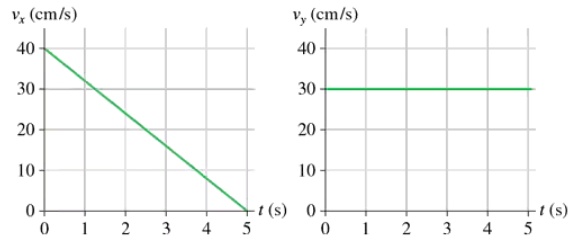
A rocket-powered hockey puck moves on a horizontal frictionless table. FIGURE EX4.6 shows graphs of vx and vy, the x- and y-components of the puck's velocity. The puck starts at the origin. How far from the origin is the puck at t = 5s?

검증된 단계별 안내
1
Step 1: Analyze the graph for the x-component of velocity (Vx). The graph shows that Vx is constant at 3 cm/s over the time interval from t = 0 to t = 5 seconds. This indicates uniform motion in the x-direction.
Step 2: Use the formula for displacement in the x-direction under constant velocity: x = Vx * t. Here, Vx = 3 cm/s and t = 5 s.
Step 3: Analyze the graph for the y-component of velocity (Vy). Since the graph for Vy is not provided, we assume Vy = 0 cm/s, meaning there is no motion in the y-direction.
Step 4: Calculate the total displacement. Since there is no motion in the y-direction, the displacement in the y-direction is zero. The total displacement is therefore equal to the displacement in the x-direction.
Step 5: Combine the displacements in the x and y directions to find the distance from the origin. Use the Pythagorean theorem: distance = sqrt(x^2 + y^2). Substitute x and y values to find the distance.

비슷한 문제에 대한 검증된 영상 답변:

이 영상 해법은 위 문제에 도움이 된다고 튜터들이 추천한 것입니다.
영상 길이:
11m
도움이 되었나요?

주요 개념

질문에 올바르게 답하기 위해 반드시 이해해야 하는 핵심 개념들은 다음과 같습니다.

Velocity Components

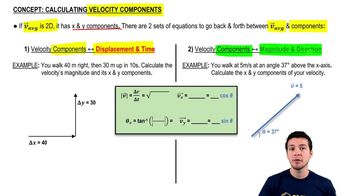
Velocity can be broken down into its components, typically in the x and y directions. In this scenario, the x-component of the velocity is constant, as indicated by the horizontal line in the graph. Understanding these components is crucial for determining the puck's position over time.
추천 영상:
가이드 코스
05:53
Calculating Velocity Components

Kinematics Equations

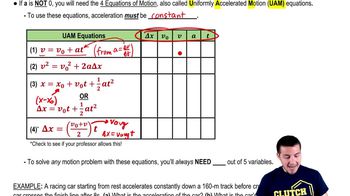
Kinematics equations describe the motion of objects under constant velocity or acceleration. For an object moving with constant velocity, the position can be calculated using the formula: position = initial position + velocity × time. This principle is essential for finding the puck's position at a given time.
추천 영상:
가이드 코스
08:25
Kinematics Equations

Frictionless Motion

In a frictionless environment, an object continues to move at a constant velocity unless acted upon by an external force. This simplifies the analysis of motion, as there are no opposing forces to consider. The hockey puck's motion on a frictionless table allows us to apply straightforward kinematic principles without complicating factors.
추천 영상: