Ch 04: Kinematics in Two Dimensions
Knight Calc - Physics for Scientists and Engineers 5th Edition
Knight Calc5th EditionPhysics for Scientists and EngineersISBN: 9780137344796당신이 사용하는 게 아니라요?교과서 변경
4장, 문제 6a

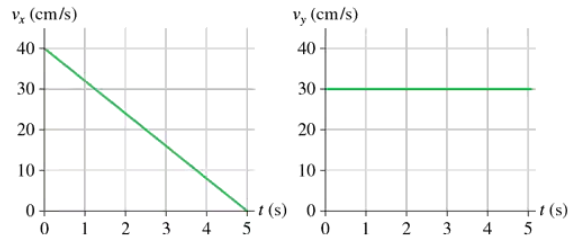
A rocket-powered hockey puck moves on a horizontal frictionless table. FIGURE EX4.6 shows graphs of vx and vy, the x- and y-components of the puck's velocity. The puck starts at the origin. In which direction is the puck moving at t = 2s? Give your answer as an angle from the x-axis.

검증된 단계별 안내
1
Step 1: Analyze the graph for the x-component of velocity (v_x). From the graph, we observe that v_x is constant at -3 m/s for all times, including t = 2s. This indicates that the puck is moving in the negative x-direction with a constant velocity.
Step 2: Analyze the graph for the y-component of velocity (v_y). At t = 2s, the graph shows that v_y is decreasing linearly. By reading the graph, we find that v_y at t = 2s is approximately 3 m/s. This indicates that the puck is moving in the positive y-direction at this instant.
Step 3: Combine the x- and y-components of velocity to determine the direction of motion. The puck's velocity vector at t = 2s can be represented as v = (-3 m/s) î + (3 m/s) ĵ, where î and ĵ are unit vectors in the x- and y-directions, respectively.
Step 4: Calculate the angle of the velocity vector relative to the x-axis. The angle θ can be found using the formula tan(θ) = v_y / v_x. Substituting the values, tan(θ) = 3 / -3.
Step 5: Solve for θ using the inverse tangent function. Since v_x is negative and v_y is positive, the angle will be in the second quadrant. Use θ = arctan(v_y / v_x) and adjust for the quadrant to find the direction of motion relative to the x-axis.

비슷한 문제에 대한 검증된 영상 답변:

이 영상 해법은 위 문제에 도움이 된다고 튜터들이 추천한 것입니다.
영상 길이:
5m
도움이 되었나요?

주요 개념

질문에 올바르게 답하기 위해 반드시 이해해야 하는 핵심 개념들은 다음과 같습니다.

Velocity Components

Velocity can be broken down into its components along the x and y axes. The x-component (vx) indicates motion in the horizontal direction, while the y-component (vy) indicates motion in the vertical direction. Understanding these components is crucial for determining the overall direction of an object's motion, especially when analyzing two-dimensional motion.
추천 영상:
가이드 코스
05:53
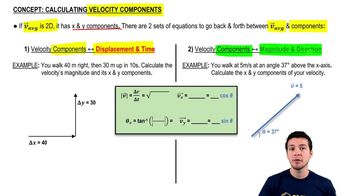
Calculating Velocity Components

Graph Interpretation

Graphs of velocity versus time provide visual representations of how an object's velocity changes over time. In this case, the x-component graph shows a constant velocity of -3 m/s, indicating motion to the left, while the y-component graph shows a linear decrease from 5 m/s to 0 m/s, indicating a change in vertical motion. Analyzing these graphs helps in determining the object's trajectory at specific time intervals.
추천 영상:
가이드 코스
07:32
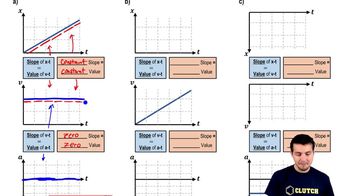
Graphing Position, Velocity, and Acceleration Graphs

Direction of Motion

The direction of motion can be expressed as an angle relative to a reference axis, typically the x-axis. This angle can be calculated using the arctangent function, which relates the y-component to the x-component of velocity. By determining the signs and magnitudes of these components at a given time, one can find the angle of the puck's motion, which is essential for understanding its trajectory.
추천 영상: