Adding Whole Numbers: 동영상 및 연습문제
Adding Whole Numbers focuses on finding the sum by combining values and keeping digits matched by place value. When adding numbers in vertical form, line up ones, tens, hundreds, and larger places, then add from right to left. If a column total is greater than a single digit, write the digit for that place and carry the extra value to the next column.
The topic also uses important properties of addition to make sums easier. The commutative property shows that changing the order of addends does not change the sum, and the associative property shows that changing the grouping does not change the sum. The addition property of 0 is written as \(a+0=a\), which means adding zero leaves a whole number unchanged. These ideas help simplify expressions and organize addition efficiently, even with larger whole numbers.
Solving Addition Problems


Find the following sums.
Find the following sums.
Find the following sums.
Solving Addition Problems Example 1
Carrying (ReGrouping) To Solve Addition Problems
Carrying (ReGrouping) To Solve Addition Problems Example 2
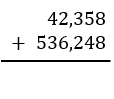
Add.

Add.

4908
Add.
Properties of Addition
Properties of Addition Example 3
Rewrite the expression using the stated property, then find the sum.
| commutative property
Rewrite the expression using the stated property, then find the sum.
| associative property
Rewrite the expression using the stated property, then find the sum.
| addition property of 0
Use the properties of addition to find the sum of the expression.
Use the properties of addition to find the sum of the expression.
학생들이 이 주제에 대해 묻는 질문은 다음과 같습니다:
When adding whole numbers, the best method is to align the numbers vertically by their place values—ones, tens, hundreds, and so on. Start adding from the rightmost column (ones place) and move left. If the sum in any column exceeds 9, write down the digit in the current place and carry over the extra value to the next column on the left. This ensures that each digit is correctly placed according to its value. For example, when adding 456 and 378, you add 6 + 8 = 14, write 4 in the ones place, and carry over 1 to the tens place. This method helps maintain accuracy and clarity, especially with larger numbers.
The commutative property of addition states that changing the order of addends does not change the sum, meaning . This allows flexibility in rearranging numbers to make addition easier. The associative property states that changing the grouping of addends does not affect the sum, so . This helps in grouping numbers strategically to simplify calculations. Both properties are useful for mental math and organizing addition problems efficiently.
The addition property of zero states that adding zero to any whole number does not change its value. Mathematically, this is expressed as . This property is important because it confirms that zero is the additive identity. When adding whole numbers, if you add zero, the sum remains the same, which can simplify expressions and calculations by eliminating unnecessary terms.
When adding whole numbers vertically, if the sum of digits in a column is greater than 9, you write the rightmost digit of the sum in that column and carry over the remaining digit(s) to the next column on the left. For example, if you add 7 + 8 = 15, write 5 in the current column and carry over 1 to the next column. This carryover is then added to the digits in the next column. This process ensures that each place value is correctly accounted for, maintaining the integrity of the number system during addition.
Lining up digits by place value—ones under ones, tens under tens, hundreds under hundreds—is crucial when adding whole numbers because it ensures that each digit is added to the correct corresponding digit. This alignment prevents errors such as adding tens to ones or hundreds to tens, which would produce incorrect sums. Proper alignment maintains the structure of the number system and allows for accurate carrying over when sums exceed 9 in any column.