Which axis is typically labeled as price and which as quantity in economics graphs?
In economics, the y-axis is labeled as price and the x-axis as quantity.
What is the first step when plotting a point from a demand schedule onto a graph?
Label the axes with price on the y-axis and quantity on the x-axis, then find the corresponding values to plot the point.
When connecting plotted points to form a curve, in which direction should you connect them?
You should connect the points from the leftmost point to the rightmost point, moving left to right.
How do you visually shift a curve to the right on a graph?
Move each point of the curve the desired number of units to the right and redraw the curve parallel to the original.
What does the slope of a line represent in economics?
The slope represents the rate of change, showing how much the y-variable changes for each one-unit increase in the x-variable.
How do you calculate the slope of a straight line on a graph?
Use the formula rise over run, which is the change in y divided by the change in x between two points.
What is the difference between a positive and a negative slope on a graph?
A positive slope means the line goes uphill from left to right, while a negative slope means it goes downhill.
How do you find the slope at a specific point on a curve that is not a straight line?
Draw a tangent line at that point and calculate the slope of the tangent line using rise over run.
What does the arc method calculate when finding the slope of a curve?
The arc method calculates the average slope between two points on the curve over a specific region.
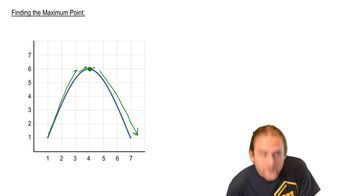
How do you identify the maximum point on a graph?
The maximum point is where the graph changes direction from rising to falling, forming a peak.
What is the formula for the area of a triangle on a graph, and how do you determine base and height?
The area is ½ × base × height, where the base and height are the lengths of the triangle's sides found from the graph's coordinates.
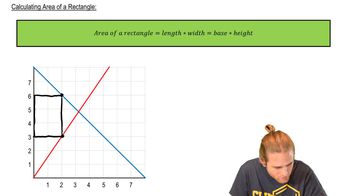
How do you calculate the area of a rectangle on a graph?
Multiply the base (horizontal length) by the height (vertical length) using the coordinates from the graph.
What is the difference between correlation and causation when interpreting graphs?
Correlation is when two variables move together, while causation means one variable directly causes a change in the other.
What is omitted variable bias in the context of interpreting graphs?
Omitted variable bias occurs when a relevant variable is left out of the analysis, potentially leading to incorrect conclusions.
What is reverse causality, and how can it affect the interpretation of a graph?
Reverse causality is when the direction of cause and effect is mistaken, such as thinking the effect causes the cause rather than the other way around.
 Back
Back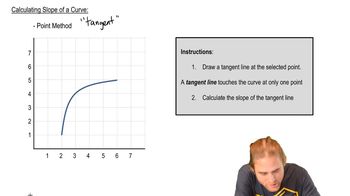
 03:40
03:40