Back

Attenuated Vaccines quiz

Control buttons has been changed to "navigation" mode.
1/15
  • What is the main method used to weaken pathogens in attenuated vaccines?

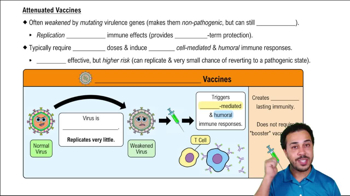
    Pathogens are weakened by mutating their virulence genes, making them non-pathogenic.
  • Why is the ability of attenuated vaccines to replicate within the host important?

    Replication allows the vaccine to amplify immune effects, leading to long-term protection.
  • Which two types of immune responses are triggered by attenuated vaccines?

    Attenuated vaccines trigger both cell-mediated and humoral immune responses.
  • How does the number of doses required for attenuated vaccines generally compare to inactivated vaccines?

    Attenuated vaccines usually require fewer doses and often do not need booster doses.
  • What is a well-known example of an attenuated vaccine?

    The measles vaccine is a well-known example of an attenuated vaccine.
  • Why are attenuated vaccines generally considered more effective than inactivated vaccines?

    They induce both arms of adaptive immunity and provide long-lasting protection.
  • What is a potential risk associated with attenuated vaccines?

    There is a very small chance that the weakened pathogen could revert to a pathogenic state.
  • Which groups of people are advised not to receive attenuated vaccines?

    Pregnant women and immunocompromised individuals are advised not to receive attenuated vaccines.
  • What immune cells and molecules are built up as a result of attenuated vaccination?

    Attenuated vaccines lead to the buildup of T cells, B cells, and antibodies.
  • How does the replication of attenuated vaccines compare to that of normal viruses?

    Attenuated vaccines replicate much less than normal viruses but still enough to stimulate immunity.
  • What is the main safety consideration when using attenuated vaccines?

    The main safety concern is the small risk of the vaccine strain reverting to a disease-causing form.
  • How long does protection from attenuated vaccines typically last?

    Protection is often long-term, sometimes lifelong, after just one or two doses.
  • What is the role of mutating virulence genes in the development of attenuated vaccines?

    Mutating virulence genes weakens the pathogen so it cannot cause disease but can still replicate.
  • Why do attenuated vaccines usually not require booster doses?

    Because their replication in the host amplifies the immune response, leading to lasting immunity.
  • What is the balance that must be considered when using attenuated vaccines in immunization strategies?

    The balance is between their high efficacy and the small risk of reversion to pathogenicity.