Back

How Antimicrobial Drugs Work quiz

Control buttons has been changed to "navigation" mode.
1/15
  • What is meant by selective toxicity in antimicrobial drugs?

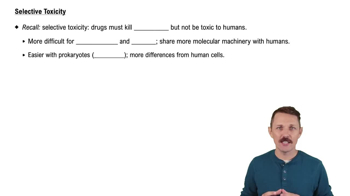
    Selective toxicity means the drug kills microbes without harming human cells, targeting features unique to the microbe.
  • Why is it harder to achieve selective toxicity against eukaryotic pathogens like fungi?

    Eukaryotic pathogens share more molecular machinery with human cells, making it difficult to find unique targets.
  • Why are viruses challenging targets for selective toxicity?

    Viruses use human cellular machinery to replicate, so there are fewer unique viral targets for drugs.
  • What makes bacteria easier targets for selective toxicity compared to fungi or viruses?

    Bacteria have more cellular differences from human cells, providing unique targets for drugs.
  • What is the primary structural component of bacterial cell walls targeted by some antibiotics?

    The bacterial cell wall is made of peptidoglycan, which is targeted by certain antibiotics.
  • How do antibacterial drugs exploit differences in cell membranes between bacteria and humans?

    Bacteria use different membrane lipids, allowing drugs to selectively target bacterial membranes.
  • What aspect of nucleic acid synthesis is targeted by some antibacterial drugs?

    Antibacterial drugs target bacterial DNA and RNA synthesis enzymes, which differ from those in humans.
  • What is the difference between bacterial and human ribosomes that allows for selective toxicity?

    Bacteria have 70S ribosomes, while humans have 80S ribosomes, enabling drugs to target bacterial protein synthesis.
  • Which metabolic pathway is commonly targeted by antibacterial drugs for selective toxicity?

    The folic acid synthesis pathway is targeted, as bacteria must produce folic acid while humans obtain it from their diet.
  • What are the five major targets of antibacterial drugs?

    The five targets are the cell wall, cell membrane, nucleic acid synthesis, ribosomes, and folic acid metabolic pathways.
  • What does the term 'bactericidal' mean regarding antibacterial drugs?

    Bactericidal drugs kill bacteria directly, often by disrupting cell walls or membranes.
  • What does 'bacteriostatic' mean in the context of antibacterial drugs?

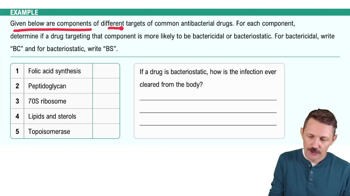
    Bacteriostatic drugs halt bacterial growth, allowing the immune system to clear the infection.
  • Which drug mechanisms are usually bactericidal?

    Drugs targeting the cell wall and cell membrane are usually bactericidal.
  • Which drug mechanisms are usually bacteriostatic?

    Drugs targeting ribosomes (protein synthesis) and metabolic pathways (like folic acid synthesis) are usually bacteriostatic.
  • Why is understanding drug targets important in antimicrobial therapy?

    Knowing drug targets helps ensure effective treatment and aids in combating antibiotic resistance.