Back

Immunoassay: ELISA quiz

Control buttons has been changed to "navigation" mode.
1/15
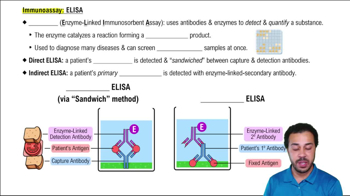
  • What does ELISA stand for?

    ELISA stands for Enzyme-Linked Immunosorbent Assay.
  • What is the main purpose of an ELISA?

    ELISA is used to detect and quantify antigens or antibodies in a sample.
  • How does the enzyme in ELISA contribute to detection?

    The enzyme catalyzes a reaction that forms a colored product, indicating successful binding.
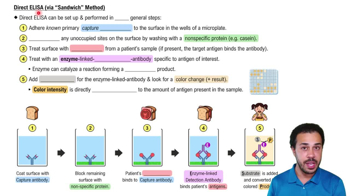
  • What does a color change in an ELISA indicate?

    A color change indicates that the target antigen or antibody is present in the sample.
  • How is the amount of antigen or antibody quantified in ELISA?

    The intensity of the color produced is directly proportional to the concentration of the target.
  • What diseases can ELISA help diagnose?

    ELISA can diagnose diseases such as HIV, chickenpox, and Lyme disease.
  • What is the first step in a direct ELISA via the sandwich method?

    A capture antibody is adhered to the surface of the well in a microplate.
  • Why is blocking with a nonspecific protein important in ELISA?

    Blocking prevents antigens and antibodies from binding to the plastic, reducing false results.
  • What is detected in a direct ELISA?

    A direct ELISA detects the patient's antigen directly.
  • What is the role of the detection antibody in direct ELISA?

    The enzyme-linked detection antibody binds to the antigen and enables color formation.
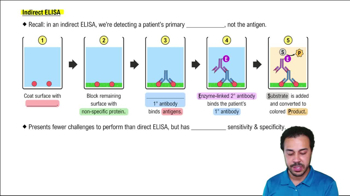
  • What is the first step in an indirect ELISA?

    The well is coated with a known target antigen.
  • What does an indirect ELISA detect?

    Indirect ELISA detects the patient's primary antibody.
  • Why do indirect ELISAs generally have lower sensitivity and specificity than direct ELISAs?

    Indirect ELISAs use only one antibody binding to the antigen, while direct ELISAs use two for double confirmation.
  • What is the function of the enzyme-linked secondary antibody in indirect ELISA?

    It binds to the patient's primary antibody and enables the colorimetric reaction.
  • How does ELISA allow for efficient screening of multiple samples?

    Different samples can be placed in separate wells of the same microplate, allowing simultaneous testing.