Back

Introduction to Microbiology definitions

Control buttons has been changed to "navigation" mode.
1/15
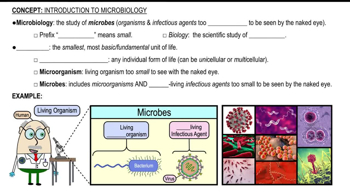
  • Microbiology

    Scientific field focused on studying organisms and infectious agents too small to be seen without magnification.
  • Microbe

    Entity encompassing both living microorganisms and nonliving infectious agents invisible to the naked eye.
  • Microorganism

    Living organism too small for unaided vision, requiring magnification for observation and study.
  • Microscope

    Instrument essential for visualizing and studying entities too small to be seen by the naked eye.
  • Cell

    Smallest and most fundamental unit of life, forming the basis of all living organisms.
  • Virus

    Nonliving infectious agent lacking many characteristics of life, yet capable of affecting living cells.
  • Bacterium

    Single-celled prokaryotic microorganism, often among the first types observed under magnification.
  • Protozoa

    Very small eukaryotic organisms, historically described as 'little animals' by early microscopists.
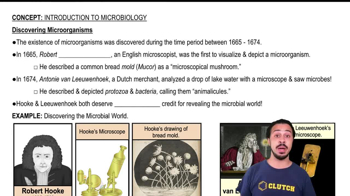
  • Robert Hooke

    English microscopist who first visualized and depicted a microorganism using early magnification tools.
  • Antony van Leeuwenhoek

    Dutch merchant who observed and illustrated diverse microbes, including protozoa and bacteria, in lake water.
  • Infectious Agent

    Entity, living or nonliving, capable of causing infection in other organisms, often studied in microbiology.
  • Multicellular Organism

    Life form composed of multiple cells, such as humans, contrasting with single-celled entities.
  • Unicellular Organism

    Life form consisting of only one cell, often requiring magnification for observation.
  • Bacteriophage

    Virus that specifically infects bacteria, commonly visualized in studies of the microbial world.
  • Animalcule

    Historical term for tiny organisms observed by early microscopists, meaning 'little animals.'