Introduction to Microbiology quiz #12 Flashcards

Introduction to Microbiology quiz #12
Control buttons has been changed to "navigation" mode.
1/10
  • Which activity has the greatest food safety risk to the customer when an employee uses bare hands
    Handling ready-to-eat food with bare hands poses the greatest risk.
  • Rhizopus hyphae form a mass called a(n) that is observable on moldy bread.
    They form a mycelium.
  • Penicillin is an antibiotic that is produced naturally by certain fungi.
    True. Penicillin is produced by Penicillium fungi.
  • Label the photomicrograph
    Identify and label the structures or organisms shown in the photomicrograph.
  • An inanimate object that harbors and transmits a pathogen is a
    It is called a fomite.
  • All of these are ways to prevent the spread of germs except
    Ignoring hand hygiene does not prevent the spread of germs.
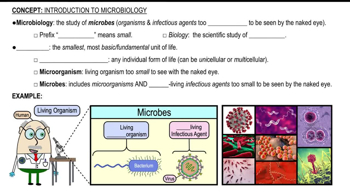
  • What is the main tool used by microbiologists to study organisms too small to be seen with the naked eye?
    Microbiologists use microscopes to study microbes that are too small to be seen unaided.
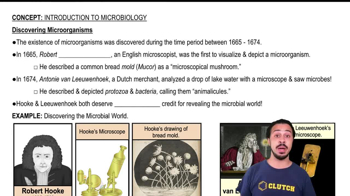
  • Who was the first person to visualize and draw a microorganism, and what did he observe?
    Robert Hooke was the first to visualize and draw a microorganism, specifically a bread mold he called a microscopical mushroom.
  • What term did Antony van Leeuwenhoek use to describe the microorganisms he observed in lake water?
    He called them 'animalcules,' meaning little animals.
  • How do the definitions of 'microorganism' and 'microbe' differ in microbiology?
    Microorganism refers only to living organisms too small to be seen unaided, while microbe includes both these living organisms and nonliving infectious agents like viruses.