Back

Introduction to Vaccines quiz

Control buttons has been changed to "navigation" mode.
1/15
  • What is artificial active immunity and how do vaccines induce it?

    Artificial active immunity is when the body is exposed to antigens through medical intervention, allowing it to build its own immunity. Vaccines induce this by safely exposing the body to antigens.
  • What was variolation and why is it no longer used?

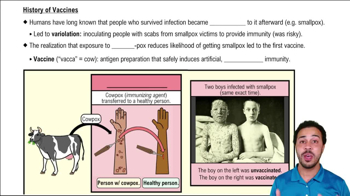
    Variolation was the practice of deliberately inoculating healthy people with smallpox scabs to induce immunity. It is no longer used because it was risky and carried several hazards.
  • How did the first vaccine differ from variolation?

    The first vaccine used cowpox, a less severe disease, to induce immunity to smallpox. Variolation used material from smallpox itself, which was more dangerous.
  • What is the origin of the word 'vaccine'?

    The word 'vaccine' comes from the Latin word 'vaca,' meaning cow, referencing the use of cowpox in the first vaccine.
  • What is an attenuated vaccine?

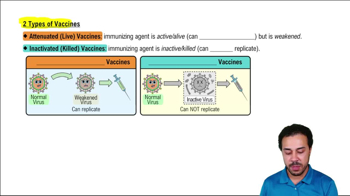
    An attenuated vaccine contains a weakened live agent that can replicate in the host but does not cause disease.
  • What is an inactivated vaccine?

    An inactivated vaccine uses non-replicating or killed pathogens or subunits, so it cannot replicate in the host.
  • How do attenuated and inactivated vaccines differ in terms of replication?

    Attenuated vaccines can replicate within the host, while inactivated vaccines cannot.
  • Why was smallpox considered one of humanity's greatest killers?

    Smallpox had a high mortality rate, meaning many people who contracted it did not survive.
  • What role did cowpox play in the development of vaccines?

    Exposure to cowpox, which is less severe than smallpox, was found to protect against smallpox and led to the creation of the first vaccine.
  • How do vaccines contribute to disease eradication?

    Vaccines stimulate immune responses, including memory cells, which enhance protection and can lead to the eradication of diseases like smallpox.
  • What is the main purpose of a vaccine?

    The main purpose of a vaccine is to safely induce immunity by exposing the body to antigens.
  • What is the significance of memory cells in vaccination?

    Memory cells are produced in response to vaccination and help the immune system respond more effectively to future exposures to the pathogen.
  • What is a zoonosis, and how is cowpox an example?

    A zoonosis is a disease that primarily exists in animals but can be transferred to humans. Cowpox is a zoonosis that mainly affects cows but can infect humans.
  • What is the foundational difference between attenuated and inactivated vaccines?

    The foundational difference is whether the immunizing agent can replicate in the host: attenuated can, inactivated cannot.
  • Why is understanding vaccine types important in immunology?

    Understanding vaccine types helps explain how immunity is developed, how pathogens interact with hosts, and informs strategies for preventing infectious diseases.