Back

Phagoctytosis quiz

Control buttons has been changed to "navigation" mode.
1/15
  • What is phagocytosis?

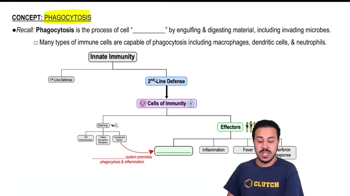
    Phagocytosis is the process by which immune cells engulf and digest invading microbes or particles from the environment.
  • Which immune cells are capable of phagocytosis?

    Macrophages, dendritic cells, and neutrophils are all capable of performing phagocytosis.
  • What is the first step of phagocytosis?

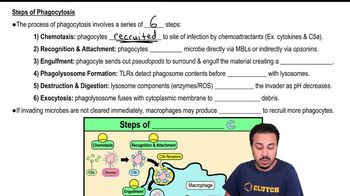
    The first step is chemotaxis, where phagocytes are attracted to the site of infection by chemoattractants.
  • What are chemoattractants and give an example?

    Chemoattractants are chemicals that attract phagocytes to the infection site; examples include cytokines like chemokines and C5a.
  • What happens during the recognition and attachment step of phagocytosis?

    Phagocytes recognize and bind to microbes either directly via mannose binding lectins or indirectly via opsonins like C3b.
  • What is the role of opsonins in phagocytosis?

    Opsonins coat the surface of microbes to enhance their recognition and binding by phagocytes, improving phagocytosis efficiency.
  • Describe the engulfment step in phagocytosis.

    During engulfment, the phagocyte extends pseudopods to surround and ingest the microbe, forming a membrane-bound structure called a phagosome.
  • What is a phagosome?

    A phagosome is a membrane-bound compartment within the phagocyte that contains the ingested microbe.
  • What occurs during phagolysosome formation?

    The phagosome fuses with lysosomes, forming a phagolysosome where digestive enzymes and reactive oxygen species are introduced.
  • What is the main function of lysosomes in phagocytosis?

    Lysosomes provide digestive enzymes and reactive oxygen species that help degrade and destroy the engulfed microbe.
  • How are microbes destroyed and digested in phagocytosis?

    Within the phagolysosome, hydrolytic enzymes and a decreased pH break down and destroy the microbe.
  • What is exocytosis in the context of phagocytosis?

    Exocytosis is the final step where the phagolysosome fuses with the cell membrane to expel degraded microbial debris.
  • Why is the sequence of phagocytosis steps important for students to learn?

    Understanding the correct order of the steps is crucial for mastering the process and preparing for microbiology exams.
  • What can happen if invading microbes are not cleared immediately by phagocytes?

    Phagocytes can produce cytokines to recruit more phagocytes to the infection site, enhancing the immune response.
  • How does the complement system relate to phagocytosis?

    The complement system can trigger phagocytosis by marking microbes with opsonins like C3b, facilitating their recognition and elimination.