Where is the site of protein synthesis in a bacterial cell?
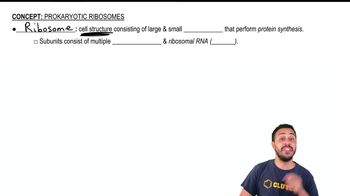
The site of protein synthesis in a bacterial cell is the ribosome, specifically the 70S ribosome composed of a 50S large subunit and a 30S small subunit.
In a bacterium, where are proteins synthesized?
Proteins in a bacterium are synthesized at the ribosomes, which are 70S structures made up of a 50S large subunit and a 30S small subunit.
What does the Svedberg unit (S) measure in relation to ribosomes?
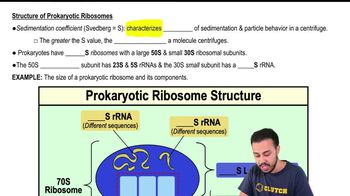
The Svedberg unit measures the rate of sedimentation of a particle in a centrifuge, indicating its size and density.
Which ribosomal RNAs are found in the 50S large subunit of prokaryotic ribosomes?
The 50S large subunit contains 23S and 5S ribosomal RNAs.
What ribosomal RNA is present in the 30S small subunit of prokaryotic ribosomes?
The 30S small subunit contains the 16S ribosomal RNA.
Why can't you simply add the Svedberg values of the ribosomal subunits to get the total ribosome value?
Svedberg values are not additive because they depend on both size and shape, so the combined ribosome sediments differently than the sum of its parts.
How do archaeal ribosomes differ from bacterial ribosomes in terms of protein content?
Archaeal ribosomes have more proteins in each subunit compared to bacterial ribosomes.
Why are antibiotics that target bacterial ribosomes often ineffective against archaeal ribosomes?
Antibiotics are often ineffective because archaeal ribosomes have different rRNA sequences and more proteins, making them structurally distinct from bacterial ribosomes.
What is the function of the three compartments found in the prokaryotic ribosome?
The three compartments serve as the active site for protein synthesis during translation.
What is the main structural difference between prokaryotic and eukaryotic ribosomes?
Prokaryotic ribosomes are 70S, while eukaryotic ribosomes have a different Svedberg value and structure, which will be discussed later in the course.