Ch. 14 - Infection, Infectious Diseases, and Epidemiology
Chapter 11, Problem 14.1a

List four types of symbiotic relationships, and give an example of each.

Verified step by step guidance
1
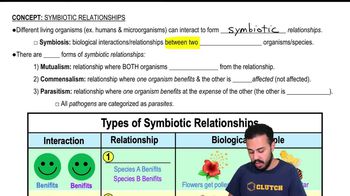
Identify the four main types of symbiotic relationships: mutualism, commensalism, parasitism, and amensalism.
For mutualism, describe a relationship where both organisms benefit. An example is the relationship between bees and flowers, where bees get nectar and flowers get pollinated.
For commensalism, describe a relationship where one organism benefits and the other is neither helped nor harmed. An example is barnacles attaching to a whale; the barnacles get a place to live and access to food, while the whale is unaffected.
For parasitism, describe a relationship where one organism benefits at the expense of the other. An example is a tapeworm in the intestines of a mammal, where the tapeworm absorbs nutrients at the host's expense.
For amensalism, describe a relationship where one organism is harmed while the other is unaffected. An example is the release of penicillin by Penicillium mold, which kills bacteria in the vicinity without affecting the mold itself.

Verified video answer for a similar problem:

This video solution was recommended by our tutors as helpful for the problem above.
Video duration:
2m
Was this helpful?

Key Concepts

Here are the essential concepts you must grasp in order to answer the question correctly.

Symbiosis

Symbiosis refers to the close and long-term interaction between two different biological species. This relationship can be beneficial, neutral, or harmful to one or both parties involved. Understanding symbiosis is crucial for identifying the various types of interactions that can occur in ecosystems.
Recommended video:
Guided course
05:59
Symbiotic Relationships

Types of Symbiotic Relationships

There are four main types of symbiotic relationships: mutualism, commensalism, parasitism, and amensalism. Mutualism benefits both species, commensalism benefits one without affecting the other, parasitism benefits one at the expense of the other, and amensalism involves one species being inhibited while the other remains unaffected. Recognizing these types helps in understanding ecological dynamics.
Recommended video:
Guided course
05:59
Symbiotic Relationships

Examples of Symbiotic Relationships

Providing examples of each type of symbiotic relationship enhances comprehension. For instance, in mutualism, bees pollinate flowers while obtaining nectar; in commensalism, barnacles attach to whales without harming them; in parasitism, ticks feed on the blood of mammals; and in amensalism, the growth of one plant species may inhibit another. These examples illustrate the practical implications of symbiotic interactions.
Recommended video:
Guided course
05:59
Symbiotic Relationships