Ch. 6 - Microbial Nutrition and Growth
Chapter 6, Problem SA7

Draw and label the four distinct phases of a bacterial growth curve. Describe what is happening within the culture as it passes through the phases.

Verified step by step guidance
1
Begin by drawing a graph with the x-axis labeled as 'Time' and the y-axis labeled as 'Number of Bacteria (log scale)'. This sets the stage for visualizing bacterial growth over time.
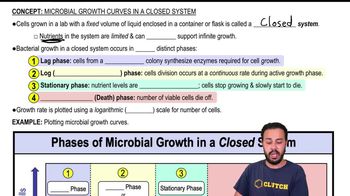
Identify and label the first phase as the 'Lag Phase'. In this phase, bacteria are metabolically active but not yet dividing rapidly. They are adapting to the new environment, synthesizing enzymes and molecules needed for growth.
Next, label the second phase as the 'Log (Exponential) Phase'. Here, bacteria divide at a constant and rapid rate, leading to exponential growth. The population size increases logarithmically as cells are in optimal conditions.
Label the third phase as the 'Stationary Phase'. During this phase, the growth rate slows and stabilizes because nutrient depletion and waste accumulation limit further growth. The number of new cells equals the number of dying cells, so the population size remains constant.
Finally, label the fourth phase as the 'Death (Decline) Phase'. In this phase, the number of dying cells exceeds the number of new cells due to continued nutrient exhaustion and toxic waste buildup, causing a decline in the overall population.

Verified video answer for a similar problem:

This video solution was recommended by our tutors as helpful for the problem above.
Video duration:
2m
Was this helpful?

Key Concepts

Here are the essential concepts you must grasp in order to answer the question correctly.

Phases of Bacterial Growth Curve

The bacterial growth curve consists of four phases: lag, log (exponential), stationary, and death. Each phase represents a different state of bacterial population dynamics in a closed culture system.
Recommended video:
Guided course
08:59
Microbial Growth Curves in a Closed System

Lag Phase

During the lag phase, bacteria adapt to their new environment, synthesizing enzymes and molecules needed for growth. Cell division is minimal, but metabolic activity is high as cells prepare for rapid multiplication.
Recommended video:
Guided course
05:15
Leading & Lagging DNA Strands

Log, Stationary, and Death Phases

In the log phase, bacteria divide at a constant, rapid rate, leading to exponential population growth. The stationary phase occurs when nutrient depletion and waste accumulation halt growth, balancing cell division and death. Finally, the death phase involves a decline in viable cells due to unfavorable conditions.
Recommended video:
Guided course
05:57
Phases of Glycolysis