Skip to main content
Nutrition
My Course
Learn
Exam Prep
AI Tutor
Study Guides
Flashcards
Try the app
My Course
Learn
Exam Prep
AI Tutor
Study Guides
Flashcards
Try the app
Back
Exercise definitions
You can tap to flip the card.
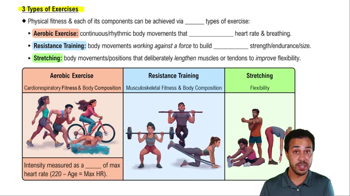
Aerobic Exercise
You can tap to flip the card.
👆
Aerobic Exercise
Continuous, rhythmic movements that elevate heart rate and breathing, primarily enhancing cardiorespiratory fitness and body composition.
Track progress
Control buttons has been changed to "navigation" mode.
1/15
Related flashcards
Related practice
Recommended videos
Exercise quiz
Exercise
15 Terms
Exercise exam
Exercise
30 Terms
Exercise quiz #1
Exercise
10 Terms
Exercise
11. Nutrition & Fitness
10 problems
Topic
Using Energy to Fuel Exercise
11. Nutrition & Fitness
10 problems
Topic
11. Nutrition & Fitness
5 topics
15 problems
Chapter
Guided course
01:39
Exercise Example 1
137
views
1
rank
Guided course
02:17
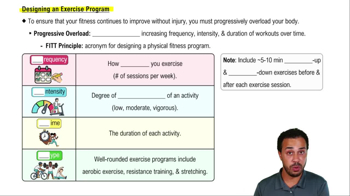
Designing an Exercise Program
145
views
1
rank
Guided course
02:17
3 Types of Exercises
161
views
2
rank
Terms in this set (15)
Hide definitions
Aerobic Exercise
Continuous, rhythmic movements that elevate heart rate and breathing, primarily enhancing cardiorespiratory fitness and body composition.
Resistance Training
Body movements against force, such as weights or bands, aimed at increasing muscle strength, endurance, and bone density.
Stretching
Deliberate lengthening of muscles or tendons to improve flexibility, supporting daily activities and overall fitness.
Cardiorespiratory Fitness
Ability of the heart and lungs to supply oxygen during sustained physical activity, improved mainly by aerobic exercise.
Body Composition
Proportion of fat, muscle, and bone in the body, influenced by both aerobic and resistance exercises.
Musculoskeletal Fitness
Strength, endurance, and health of muscles and bones, primarily developed through resistance training.
Flexibility
Capacity of muscles and joints to move through their full range of motion, essential for performance and injury prevention.
Physical Activity Guidelines
Recommendations outlining minimum weekly exercise amounts for aerobic and muscle-strengthening activities to promote health.
Maximum Heart Rate
Estimated upper limit of heartbeats per minute during intense activity, calculated as 220 minus age.
Progressive Overload
Gradual increase in exercise frequency, intensity, or duration to continually challenge the body and improve fitness.
FIT Principle
Framework for exercise program design, emphasizing frequency, intensity, time, and type of activity.
Warm Up
Short preparatory activity before exercise, intended to ready the body and mind, reducing injury risk.
Cooldown
Post-exercise activity that gradually lowers heart rate and aids recovery after physical exertion.
Moderate Intensity
Level of activity that raises heart rate to 50–70% of maximum, suitable for most aerobic exercise recommendations.
Vigorous Intensity
Level of activity that elevates heart rate to 70–85% of maximum, providing greater cardiorespiratory benefits.
 BackBack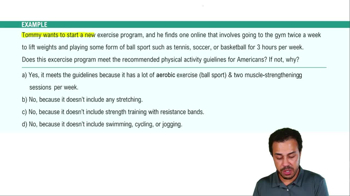
 01:39
01:39