Skip to main content
Nutrition
My Course
Learn
Exam Prep
AI Tutor
Study Guides
Flashcards
Try the app
My Course
Learn
Exam Prep
AI Tutor
Study Guides
Flashcards
Try the app
Back
Fiber and Phytochemicals definitions
You can tap to flip the card.
Non-nutritive Foods
You can tap to flip the card.
👆
Non-nutritive Foods
Substances that provide no calories, vitamins, or minerals, yet may offer health benefits when included in the diet.
Track progress
Control buttons has been changed to "navigation" mode.
1/15
Related flashcards
Related practice
Recommended videos
Fiber and Phytochemicals quiz
Fiber and Phytochemicals
15 Terms
Fiber and Phytochemicals exam
Fiber and Phytochemicals
26 Terms
Fiber and Phytochemicals
1. Science of Nutrition
10 problems
Topic
Energy in Food
1. Science of Nutrition
10 problems
Topic
1. Science of Nutrition
8 topics
15 problems
Chapter
03:34
Non-nutritive Foods
653
views
15
rank
01:17
Fiber and Phytochemicals Example 1
503
views
15
rank
Terms in this set (15)
Hide definitions
Non-nutritive Foods
Substances that provide no calories, vitamins, or minerals, yet may offer health benefits when included in the diet.
Fiber
Indigestible plant carbohydrate that adds bulk to feces, aiding digestion and linked to lower cancer and heart disease risk.
Phytochemicals
Plant-derived compounds, not essential nutrients, associated with reduced inflammation and cancer risk.
Soluble Fiber
Type of fiber that dissolves in water, forming a viscous gel in the digestive tract.
Insoluble Fiber
Type of fiber that does not dissolve in water, contributing to fecal bulk and easier bowel movements.
Carbohydrates
Major energy-providing macronutrients, some forms of which are indigestible and classified as fiber.
Constipation
Digestive condition often relieved by increased fiber intake due to enhanced fecal bulk and movement.
Antioxidants
Molecules that protect cells from damage, some of which are found among phytochemicals.
Polyphenols
A group of phytochemicals found in plants, often acting as antioxidants and contributing to health benefits.
Carotenoids
Pigmented phytochemicals in plants, some of which function as antioxidants and may reduce disease risk.
Flavonoids
A class of phytochemicals present in many fruits and vegetables, linked to various health-promoting effects.
Fecal Bulk
Increased mass of stool resulting from fiber intake, promoting easier passage through the digestive tract.
Plant Compounds
Bioactive substances found in plants, including phytochemicals, that may influence human health.
Varied Diet
Eating pattern rich in diverse vegetables, enhancing intake of fiber and phytochemicals for overall health.
Non-nutritive Sweeteners
Substances used to replace sugar, providing sweetness without adding calories or nutrients.
 BackBack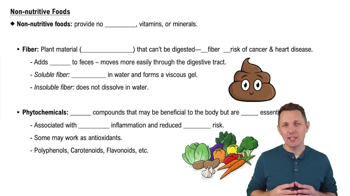
 03:34
03:34