Skip to main content
Nutrition
My Course
Learn
Exam Prep
AI Tutor
Study Guides
Flashcards
Try the app
My Course
Learn
Exam Prep
AI Tutor
Study Guides
Flashcards
Try the app
Back
Fiber and Phytochemicals exam
You can tap to flip the card.
What is a non-nutritive food?
You can tap to flip the card.
👆
What is a non-nutritive food?
A food that provides no calories, vitamins, or minerals.
Track progress
Control buttons has been changed to "navigation" mode.
1/26
Related flashcards
Related practice
Recommended videos
Fiber and Phytochemicals definitions
Fiber and Phytochemicals
15 Terms
Fiber and Phytochemicals quiz
Fiber and Phytochemicals
15 Terms
Fiber and Phytochemicals
1. Science of Nutrition
10 problems
Topic
Energy in Food
1. Science of Nutrition
10 problems
Topic
1. Science of Nutrition
8 topics
15 problems
Chapter
03:34
Non-nutritive Foods
653
views
15
rank
01:17
Fiber and Phytochemicals Example 1
503
views
15
rank
Terms in this set (26)
Hide definitions
What is a non-nutritive food?
A food that provides no calories, vitamins, or minerals.
Fiber
A type of carbohydrate from plants that cannot be digested by the human body.
Phytochemicals
Plant compounds that may offer health benefits but are not essential nutrients.
What are the two main types of fiber?
Soluble fiber and insoluble fiber.
Soluble Fiber
Fiber that dissolves in water and forms a viscous gel in the digestive tract.
Insoluble Fiber
Fiber that does not dissolve in water and adds bulk to feces.
What is the main function of fiber in the digestive tract?
It adds bulk to feces, helping it move more easily through the digestive tract.
How does fiber intake affect cancer and heart disease risk?
Higher fiber intake is associated with decreased risk of certain cancers and heart disease.
Non-nutritive sweeteners
Substances that taste sweet but provide no calories.
What does 'phyto' mean in phytochemicals?
'Phyto' means plant.
Are phytochemicals essential nutrients?
No, they are not essential but may be beneficial.
What are some examples of phytochemicals?
Polyphenols, carotenoids, and flavonoids.
How do phytochemicals potentially benefit health?
They may reduce inflammation and cancer risk.
Antioxidants
Molecules that protect cells from damage.
What is the best way to increase phytochemical intake?
Eat a varied diet rich in vegetables.
Why are fiber supplements sometimes used?
To relieve constipation by adding bulk to feces.
Do all carbohydrates provide energy?
No, fiber is a carbohydrate that does not provide energy.
What happens to fiber in the digestive tract?
It passes through undigested and is excreted.
What is the relationship between fiber and weight gain?
Higher fiber intake is associated with reduced weight gain.
How many phytochemicals have been identified?
About 10,000 different phytochemicals.
What is the main source of fiber and phytochemicals in the diet?
Vegetables and other plant foods.
Viscous gel
A thick, jelly-like substance formed by soluble fiber in the digestive tract.
What is the effect of insoluble fiber on feces?
It increases fecal bulk and helps prevent constipation.
Are the health benefits of phytochemicals fully understood?
No, the exact mechanisms are not fully known.
What is a major energy source for the body?
Carbohydrates (excluding fiber).
What is the role of antioxidants among phytochemicals?
Some phytochemicals act as antioxidants.
 BackBack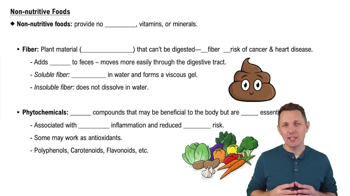
 03:34
03:34