Skip to main content
Nutrition
My Course
Learn
Exam Prep
AI Tutor
Study Guides
Flashcards
Try the app
My Course
Learn
Exam Prep
AI Tutor
Study Guides
Flashcards
Try the app
Back
Fiber exam
You can tap to flip the card.
What is fiber?
You can tap to flip the card.
👆
What is fiber?
A group of non-digestible carbohydrates, mostly plant-based polysaccharides, that provide health benefits.
Track progress
Control buttons has been changed to "navigation" mode.
1/29
Related flashcards
Related practice
Recommended videos
Fiber definitions
Fiber
15 Terms
Fiber quiz
Fiber
15 Terms
Fiber
4. Carbohydrates
10 problems
Topic
Carbohydrate Digestion
4. Carbohydrates
10 problems
Topic
4. Carbohydrates
9 topics
15 problems
Chapter
Guided course
01:53
Fiber Example 2
278
views
7
rank
Guided course
03:00
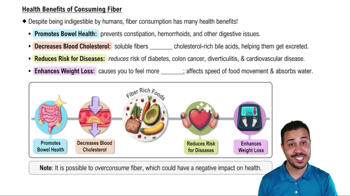
Health Benefits of Consuming Fiber
322
views
6
rank
Guided course
02:08
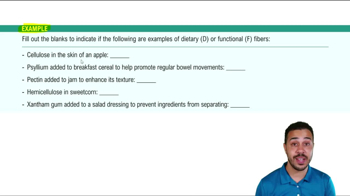
Fiber Example 1
297
views
5
rank
Terms in this set (29)
Hide definitions
What is fiber?
A group of non-digestible carbohydrates, mostly plant-based polysaccharides, that provide health benefits.
Dietary Fiber
Fiber naturally occurring in foods, such as fruits, vegetables, and whole grains.
What is functional fiber?
Fiber that is chemically extracted, isolated, and added to foods for health benefits.
Total Fiber
The sum of dietary fiber and functional fiber in a food.
What is the main difference between dietary and functional fiber?
Dietary fiber is naturally present in foods; functional fiber is added to foods after extraction.
Soluble Fiber
Fiber that dissolves in water, forms a gel, and can help lower blood cholesterol and glucose.
What is insoluble fiber?
Fiber that does not dissolve in water and helps promote bowel regularity.
Which type of fiber is more fermentable by gut bacteria?
Soluble fiber is more fermentable by gut bacteria.
Name two examples of soluble fibers.
Pectin and beta-glucans.
What are some examples of insoluble fibers?
Cellulose, hemicellulose, and lignin.
What is the main function of insoluble fiber in the digestive tract?
Adds bulk to stool and promotes bowel regularity.
How does soluble fiber help lower blood cholesterol?
By binding to cholesterol-rich bile acids and promoting their excretion.
Whole Grains
Grains that contain all three edible parts: bran, germ, and endosperm.
Refined Grains
Grains that have had the bran and germ removed, leaving only the endosperm.
What are the three edible components of a grain kernel?
Bran, germ, and endosperm.
Enriched Grains
Refined grains with some nutrients added back after processing.
Fortified Grains
Grains with new nutrients added that were not originally present.
What is the main nutritional difference between whole and refined grains?
Whole grains are more nutrient-dense and higher in fiber than refined grains.
What are some food sources high in soluble fiber?
Oats, barley, apples, citrus fruits, and legumes.
Name food sources rich in insoluble fiber.
Whole grains, vegetables, nuts, and seeds.
How does fiber aid in weight management?
By increasing satiety, making you feel fuller for longer.
What health risks are reduced by adequate fiber intake?
Diabetes, colon cancer, diverticulitis, and cardiovascular disease.
What can happen if you consume too much fiber?
Overconsumption can lead to health issues such as digestive discomfort.
Why is it important to drink water when consuming fiber?
Fiber absorbs water, so adequate hydration prevents constipation.
Pectin
A soluble fiber found in fruits, used as both dietary and functional fiber.
What is the role of fiber in blood glucose regulation?
Slows nutrient absorption, preventing spikes in blood glucose.
What is the effect of insoluble fiber on digestive speed?
It moves quickly through the digestive tract.
What is the effect of soluble fiber on digestive speed?
It moves slowly through the digestive tract due to gel formation.
Why are whole grains considered more healthful than refined grains?
They retain all parts of the grain and thus more nutrients and fiber.
 BackBack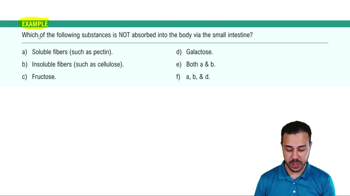
 01:53
01:53