Skip to main content
Nutrition
My Course
Learn
Exam Prep
AI Tutor
Study Guides
Flashcards
Try the app
My Course
Learn
Exam Prep
AI Tutor
Study Guides
Flashcards
Try the app
Back
Healthful Eating exam
You can tap to flip the card.
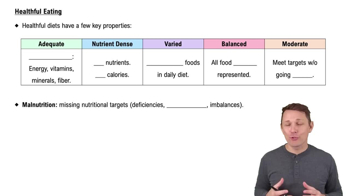
What are the five key properties of a healthful diet?
You can tap to flip the card.
👆
What are the five key properties of a healthful diet?
Adequacy, nutrient density, variety, balance, and moderation.
Track progress
Control buttons has been changed to "navigation" mode.
1/29
Related flashcards
Related practice
Recommended videos
Healthful Eating definitions
Healthful Eating
14 Terms
Healthful Eating quiz
Healthful Eating
15 Terms
Healthful Eating quiz #1
Healthful Eating
10 Terms
Healthful Eating
2. Tools for Healthful Eating
10 problems
Topic
Three Guides to a Healthful Diet
2. Tools for Healthful Eating
10 problems
Topic
2. Tools for Healthful Eating
4 topics
15 problems
Chapter
05:24
Nutrient and Energy Density
524
views
8
rank
03:38
Healthful Eating
711
views
24
rank
01:55
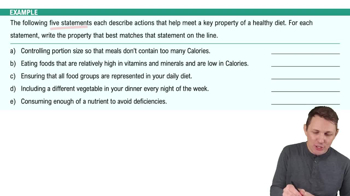
Healthful Eating Example 1
486
views
15
rank
Terms in this set (29)
Hide definitions
What are the five key properties of a healthful diet?
Adequacy, nutrient density, variety, balance, and moderation.
Adequacy
Ensuring sufficient intake of essential nutrients and energy.
What does 'nutrient density' mean?
A food's nutrient content relative to its calorie content.
Variety
Including diverse foods in the daily diet to prevent deficiencies.
Balance
Representing all food groups in appropriate proportions.
Moderation
Meeting nutritional targets without excess or deficiency.
What is malnutrition?
A state resulting from deficiencies, excesses, or imbalances in nutrient intake.
Undernutrition
Lacking sufficient intake of a specific nutrient or energy.
Overnutrition
Consuming too much of a nutrient or energy.
What are nutrient-dense foods?
Foods high in vitamins, minerals, healthy oils, and fiber relative to calories.
Give examples of nutrient-dense foods.
Vegetables, fruits, whole grains, legumes, and fish.
What are low nutrient-dense foods?
Foods low in vitamins, minerals, healthy oils, and fiber, often high in fat and added sugars.
Empty calories
Calories that provide little or no nutrients.
What foods are considered sources of empty calories?
Sweets, sodas, alcohol, pizza, and processed foods.
Nutrient Density (calculation)
Amount of a nutrient divided by the number of calories in a food.
Energy Density
Amount of calories in a food relative to its weight.
What makes a food high in energy density?
High fat, oil, and added sugar content; low in fiber and water.
What makes a food low in energy density?
High in fiber and water, low in fat, oil, and added sugars.
Why is variety important in a healthful diet?
Prevents nutrient deficiencies by providing a range of nutrients.
How does fiber affect energy density?
Increases food weight without adding calories, lowering energy density.
What is the 'Goldilocks zone' in nutrition?
The range of nutrient intake that is neither too low nor too high—adequate and moderate.
Why are whole foods emphasized in a healthful diet?
They are typically more nutrient-dense and less energy-dense than processed foods.
How does water content affect energy density?
Higher water content lowers energy density by increasing weight without adding calories.
Give examples of high energy density foods.
Fats, oils, butter, potato chips, chocolate sandwich cookies.
Give examples of low energy density foods.
Whole fruits, vegetables, carrots, apples.
What is the relationship between energy density and nutrient density?
Foods can be high in energy density but low in nutrient density, and vice versa.
How can overnutrition occur?
By consuming excessive calories or nutrients beyond the body's needs.
What is the main risk of eating only a single food, even if nutritious?
Potential nutrient deficiencies due to lack of variety.
Why is moderation important in a healthful diet?
Prevents both deficiencies and excesses, supporting optimal health.
 BackBack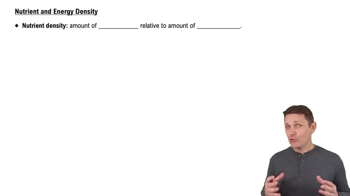
 05:24
05:24