Skip to main content
Nutrition
My Course
Learn
Exam Prep
AI Tutor
Study Guides
Flashcards
Try the app
My Course
Learn
Exam Prep
AI Tutor
Study Guides
Flashcards
Try the app
Back
Hypertension and Minerals exam
You can tap to flip the card.
What is hypertension?
You can tap to flip the card.
👆
What is hypertension?
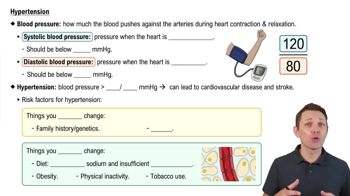
A condition where blood pressure is consistently above 130/80 mmHg.
Track progress
Control buttons has been changed to "navigation" mode.
1/29
Related flashcards
Related practice
Recommended videos
Hypertension and Minerals definitions
Hypertension and Minerals
15 Terms
Hypertension and Minerals quiz
Hypertension and Minerals
15 Terms
Hypertension and Minerals quiz #1
Hypertension and Minerals
10 Terms
Hypertension and Minerals
8. Water and Minerals
10 problems
Topic
Major Mineral: Calcium and Phosphorus
8. Water and Minerals
10 problems
Topic
8. Water and Minerals
10 topics
15 problems
Chapter
02:08
Hypertension and Minerals Example 1
176
views
3
rank
04:40
Hypertension
213
views
3
rank
03:05
DASH Diet
234
views
3
rank
Terms in this set (29)
Hide definitions
What is hypertension?
A condition where blood pressure is consistently above 130/80 mmHg.
Systolic Blood Pressure
The pressure in arteries when the heart contracts; the higher number in a blood pressure reading.
What is the recommended daily sodium intake to help prevent hypertension?
Less than 2,300 mg per day.
Diastolic Blood Pressure
The pressure in arteries when the heart is relaxed; the lower number in a blood pressure reading.
What does DASH stand for?
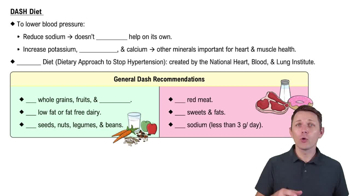
Dietary Approaches to Stop Hypertension.
Electrolyte
A mineral that carries an electric charge and helps regulate fluid balance in the body.
Which minerals are emphasized in the DASH diet?
Potassium, magnesium, and calcium.
What is the main effect of high sodium intake on blood pressure?
It increases blood volume, raising blood pressure.
Potassium
A mineral and electrolyte mainly found inside cells, important for normal blood pressure.
What are two unchangeable risk factors for hypertension?
Genetics (family history) and age.
Magnesium
A mineral important for heart and muscle health, and acts as an electrolyte.
What is the target healthy blood pressure?
Below 120/80 mmHg.
How does potassium intake affect blood pressure?
Higher potassium intake helps lower blood pressure.
Calcium
A mineral important for muscle function and blood pressure regulation.
What foods does the DASH diet recommend maximizing?
Whole grains, fruits, vegetables, low-fat dairy, nuts, seeds, legumes, and beans.
What is a diuretic?
A medication that increases urine production to lower blood volume and blood pressure.
What foods should be minimized in the DASH diet?
Red meat, sweets, saturated fats, and sodium.
How does obesity affect hypertension risk?
Obesity increases the risk of developing hypertension.
Sodium
A mineral and electrolyte mainly found outside cells, excess intake raises blood pressure.
What is the average American sodium intake per day?
About 3,400 mg per day.
What is the role of physical activity in blood pressure?
Physical activity can lower blood pressure by strengthening the heart.
What is the effect of tobacco use on blood pressure?
Tobacco use increases the risk of hypertension.
What is the main goal of the DASH diet?
To lower blood pressure and reduce the risk of hypertension.
What happens to blood pressure during heart contraction?
It increases, measured as systolic pressure.
What is the effect of low potassium intake?
It increases the risk of hypertension.
Why is balancing sodium and potassium important?
It helps regulate fluid balance and maintain normal blood pressure.
What is the relationship between age and hypertension risk?
Risk for hypertension increases with age.
What is the main cause of death related to hypertension?
Cardiovascular disease and stroke.
What is the effect of excess blood volume on blood pressure?
It raises blood pressure.
 BackBack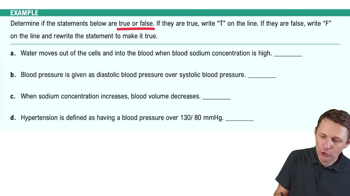
 02:08
02:08