Skip to main content
Nutrition
My Course
Learn
Exam Prep
AI Tutor
Study Guides
Flashcards
Try the app
My Course
Learn
Exam Prep
AI Tutor
Study Guides
Flashcards
Try the app
Back
Intro to Carbohydrates exam
You can tap to flip the card.
What are carbohydrates?
You can tap to flip the card.
👆
What are carbohydrates?
Carbohydrates are one of the three macronutrients, made up of saccharides (sugars), and serve as a primary energy source.
Track progress
Control buttons has been changed to "navigation" mode.
1/29
Related flashcards
Related practice
Recommended videos
Intro to Carbohydrates definitions
Intro to Carbohydrates
15 Terms
Intro to Carbohydrates quiz
Intro to Carbohydrates
15 Terms
Intro to Carbohydrates
4. Carbohydrates
10 problems
Topic
Simple vs Complex Carbohydrates
4. Carbohydrates
10 problems
Topic
4. Carbohydrates
9 topics
15 problems
Chapter
Guided course
01:35
Sources of Carbohydrates
468
views
12
rank
Guided course
03:34
What are Carbohydrates?
772
views
24
rank
Guided course
03:40
Intro to Carbohydrates Example 1
501
views
15
rank
Terms in this set (29)
Hide definitions
What are carbohydrates?
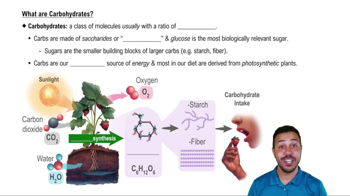
Carbohydrates are one of the three macronutrients, made up of saccharides (sugars), and serve as a primary energy source.
Saccharides
The building blocks of carbohydrates, also known as sugars.
What is the main biological sugar in carbohydrates?
Glucose.
Photosynthesis
The process by which plants convert carbon dioxide and water into sugars using sunlight.
What is the chemical formula for glucose?
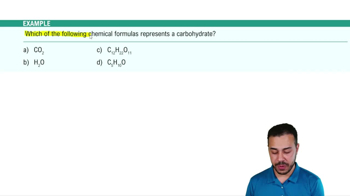
C6H12O6.
Name three major sources of carbohydrates in the diet.
Starch, fiber, and sugars.
Nutrient-dense foods
Foods that provide lots of nutrients with relatively few calories.
Which macronutrients are carbohydrates grouped with?
Proteins and lipids.
What is the primary function of carbohydrates in the body?
To serve as the main source of energy.
Simple carbohydrates
Carbohydrates made up of one or two sugar units (monosaccharides or disaccharides).
Complex carbohydrates
Carbohydrates composed of many sugar units, such as starch and fiber.
What are common food sources of carbohydrates?
Fruits, vegetables, grains, dairy products, and sweetened foods.
Which foods contain little to no carbohydrates?
Pure protein foods (like plain chicken or fish) and pure fats (like butter or oil).
What is the ratio of carbon to water in carbohydrates?
Typically one carbon atom for every water molecule.
Why are not all carbohydrates considered equally healthy?
Because some are more nutrient-dense and provide more health benefits than others.
Starch
A complex carbohydrate found in plants, made of many glucose units.
Fiber
A type of complex carbohydrate that the body cannot digest, important for digestive health.
What is a byproduct of photosynthesis besides sugars?
Oxygen gas (O2).
Sugars
Simple carbohydrates that include glucose, fructose, and sucrose.
What does 'carbohydrate' literally mean?
Hydrated carbon.
Which plant process is responsible for most dietary carbohydrates?
Photosynthesis.
What is the Greek origin of the word 'saccharide'?
It comes from the Greek word for sugar.
Are carbohydrates functionally diverse?
Yes, they perform many roles but mainly provide energy.
What are examples of sweetened foods high in carbohydrates?
Cakes, donuts, candies, and sweetened beverages.
What is the main carbohydrate in dairy products?
Lactose.
Why is glucose important?
It is the most biologically relevant sugar and a key energy source.
What is a macronutrient?
A nutrient required in large amounts, such as carbohydrates, proteins, and fats.
What is the difference between simple and complex carbohydrates?
Simple carbs have one or two sugars; complex carbs have many sugar units.
Which foods are exceptions to containing carbohydrates?
Pure protein and pure fat foods.
 BackBack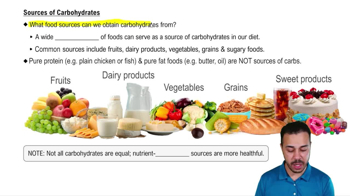
 01:35
01:35