Skip to main content
Nutrition
My Course
Learn
Exam Prep
AI Tutor
Study Guides
Flashcards
Try the app
My Course
Learn
Exam Prep
AI Tutor
Study Guides
Flashcards
Try the app
Back
Introduction to Proteins exam
You can tap to flip the card.
What are proteins made of?
You can tap to flip the card.
👆
What are proteins made of?
Proteins are made of chains of amino acids linked by peptide bonds.
Track progress
Control buttons has been changed to "navigation" mode.
1/29
Related flashcards
Related practice
Recommended videos
Introduction to Proteins definitions
Introduction to Proteins
15 Terms
Introduction to Proteins quiz
Introduction to Proteins
15 Terms
Introduction to Proteins quiz #1
Introduction to Proteins
10 Terms
Introduction to Proteins
6. Proteins
10 problems
Topic
Protein Structure
6. Proteins
10 problems
Topic
6. Proteins
7 topics
15 problems
Chapter
Guided course
02:08
What are Proteins?
387
views
9
rank
Terms in this set (29)
Hide definitions
What are proteins made of?
Proteins are made of chains of amino acids linked by peptide bonds.
Amino acids
The building blocks of proteins.
Peptide bond
A chemical bond that links amino acids together in a protein.
What is the primary function of dietary proteins after digestion?
To provide amino acids for building new proteins, nitrogen-containing molecules, or energy.
Macronutrients
Nutrients required in large amounts, including proteins, carbohydrates, and lipids.
Why are proteins considered a significant source of nitrogen?
Because they contain nitrogen, unlike carbohydrates and lipids.
List three common dietary sources of protein.
Meat, dairy, legumes.
What is the chemical symbol for nitrogen?
N
Functionally diverse molecules
Proteins, due to their varied roles in the body.
What is the typical range of amino acids in a protein?
Between 50 and 10,000 amino acids.
Last resort energy source
Proteins are used for energy only when carbohydrates and fats are unavailable.
What are nucleotides?
Nitrogen-containing molecules that are building blocks of DNA and RNA.
Which macronutrient is unique in providing nitrogen?
Protein.
Name two plant-based protein sources.
Legumes and nuts.
What are the three primary functions of proteins in the body?
Building new proteins, making nitrogen-containing molecules, and providing energy.
Dietary protein digestion
Breakdown of proteins into individual amino acids for absorption and use.
What distinguishes proteins from carbohydrates and lipids?
Proteins contain nitrogen; carbohydrates and lipids do not.
Whole grains
A plant-based food source that provides protein.
What is the role of proteins in building new molecules?
They provide amino acids to synthesize new proteins and nitrogen-containing compounds.
Seafood
An animal-based source of dietary protein.
Why is understanding protein sources important for nutrition?
Because proteins contribute to bodily processes and overall health.
Dairy products
A common animal-based source of protein.
What are the building blocks of DNA and RNA?
Nucleotides, which are nitrogen-containing molecules.
Legumes
A plant-based food group rich in protein.
How do proteins contribute to energy metabolism?
They can be used for energy when other sources are depleted.
Meat, poultry, and seafood
Examples of animal-based protein sources.
What is a unique function of proteins compared to other macronutrients?
Building nitrogen-containing molecules.
Nuts and seeds
Plant-based foods that are good sources of protein.
What is the importance of peptide bonds in proteins?
They link amino acids together to form protein chains.
 BackBack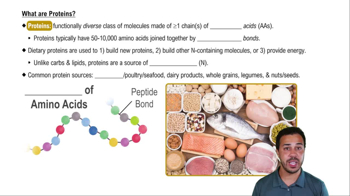
 02:08
02:08