Skip to main content
Nutrition
My Course
Learn
Exam Prep
AI Tutor
Study Guides
Flashcards
Try the app
My Course
Learn
Exam Prep
AI Tutor
Study Guides
Flashcards
Try the app
Back
Micronutrients exam
You can tap to flip the card.
What are micronutrients?
You can tap to flip the card.
👆
What are micronutrients?
Nutrients needed in small amounts, including vitamins and minerals.
Track progress
Control buttons has been changed to "navigation" mode.
1/29
Related flashcards
Related practice
Recommended videos
Micronutrients definitions
Micronutrients
14 Terms
Micronutrients quiz
Micronutrients
15 Terms
Micronutrients quiz #1
Micronutrients
10 Terms
Micronutrients
1. Science of Nutrition
10 problems
Topic
Fiber and Phytochemicals
1. Science of Nutrition
10 problems
Topic
1. Science of Nutrition
8 topics
15 problems
Chapter
06:03
Vitamins & Minerals
793
views
28
rank
03:04
Micronutrients Example 1
574
views
16
rank
Terms in this set (29)
Hide definitions
What are micronutrients?
Nutrients needed in small amounts, including vitamins and minerals.
Vitamins
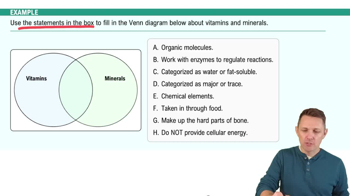
Organic compounds essential for various physiological functions.
Do vitamins and minerals provide energy?
No, they do not provide energy.
Water-soluble vitamins
Vitamins B and C; not stored in the body and excess is excreted in urine.
Fat-soluble vitamins
Vitamins A, D, E, and K; stored in the body and can be toxic in excess.
What is the main risk of excess fat-soluble vitamin intake?
Potential toxicity, which can be harmful or even deadly.
How many vitamins are there?
There are 13 essential vitamins.
Antioxidants
Molecules that protect cells from damage, e.g., vitamins C and E.
What is the role of vitamin D?
Acts as a signaling molecule for proper bone development and nutrient absorption.
Enzyme
A protein that speeds up chemical reactions in cells.
How do some vitamins interact with enzymes?
They work with enzymes to regulate reactions in the body.
Minerals
Inorganic elements required for various body functions.
Major minerals
Minerals needed in amounts greater than 100 mg per day (e.g., calcium, sodium).
Trace minerals
Minerals needed in amounts less than 100 mg per day (e.g., iron, iodine).
What is the main structural role of minerals?
Building bones and teeth (e.g., calcium and phosphate).
How are minerals classified?
By the amount needed: major (>100 mg/day) and trace (<100 mg/day).
What is the best source of vitamins and minerals?
A varied diet.
When is supplementation recommended?
In specific cases, such as iron deficiency.
Are minerals organic or inorganic?
Inorganic.
What is the function of sodium in the body?
Maintains cellular ion balance.
What happens to excess water-soluble vitamins?
They are excreted in urine.
What is hypervitaminosis A?
Toxicity from excessive vitamin A intake.
How many essential minerals are there?
16.
What is a supplement?
A product taken to provide nutrients that may be missing from the diet.
Why is a varied diet emphasized for micronutrient intake?
It ensures adequate and balanced intake of all essential vitamins and minerals.
What is the difference between vitamins and minerals?
Vitamins are organic compounds; minerals are inorganic elements.
Name two examples of trace minerals.
Iron and iodine.
What is the role of zinc in the body?
Works with enzymes to regulate reactions.
What is the risk of taking too many supplements?
Possible toxicity, especially with fat-soluble vitamins.
 BackBack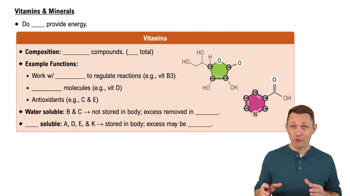
 06:03
06:03