Skip to main content
Nutrition
My Course
Learn
Exam Prep
AI Tutor
Study Guides
Flashcards
Try the app
My Course
Learn
Exam Prep
AI Tutor
Study Guides
Flashcards
Try the app
Back
Nutritional Needs for Infants definitions
You can tap to flip the card.
Breast Milk
You can tap to flip the card.
👆
Breast Milk
Primary infant food source, rich in fat and nutrients, meeting hydration and energy needs for the first year.
Track progress
Control buttons has been changed to "navigation" mode.
1/15
Related flashcards
Related practice
Recommended videos
Nutritional Needs for Infants quiz
Nutritional Needs for Infants
15 Terms
Nutritional Needs for Infants
14. Nutrition: Pregnancy Through Infancy
10 problems
Topic
Breastfeeding
14. Nutrition: Pregnancy Through Infancy
10 problems
Topic
14. Nutrition: Pregnancy Through Infancy
5 topics
15 problems
Chapter
Guided course
02:53
Nutritional Needs for Infants Example 3
78
views
1
rank
Guided course
02:26
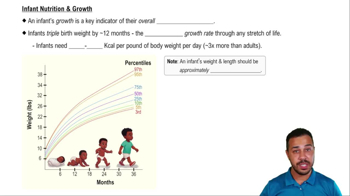
Infant Nutrition & Growth
98
views
Guided course
01:40
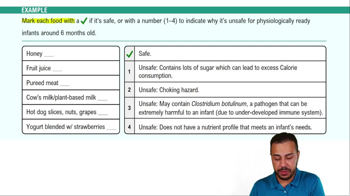
Nutritional Needs for Infants Example 2
69
views
Terms in this set (15)
Hide definitions
Breast Milk
Primary infant food source, rich in fat and nutrients, meeting hydration and energy needs for the first year.
Formula
Commercially prepared alternative to breast milk, designed to meet infants' nutritional and hydration needs.
Growth Chart
Graphical tool tracking infant weight and length percentiles to assess proportional growth and nutrition.
Percentile
Statistical measure indicating an infant's position relative to peers in weight or length on growth charts.
Iron Stores
Body reserves of a mineral that become depleted by six months, requiring dietary replenishment from solid foods.
Vitamin K Injection
Postnatal intervention preventing blood clotting issues due to lack of gut bacteria in newborns.
Vitamin D Supplement
Recommended addition for breastfed infants to compensate for naturally low levels in breast milk.
Choking Hazard
Food items like grapes or nuts that pose a risk of airway blockage in infants.
Clostridium botulinum
Bacterium found in honey that can cause fatal illness in infants with immature immune systems.
Hydration
Adequate fluid intake, primarily provided by breast milk or formula, essential for infant health.
Semi Solid Foods
Transitional foods introduced around six months, such as pureed meats, to support nutritional needs.
Immunity
Body's defense system, supported by proper nutrition during infancy for optimal development.
Brain Development
Critical process in infancy, highly dependent on sufficient energy and nutrient intake.
Animal Milk
Dairy product not recommended for infants under one year due to inadequate nutrient composition.
Allergy Testing
Process of introducing new foods one at a time to monitor for adverse reactions in infants.
 BackBack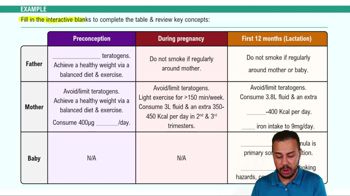
 02:53
02:53