Skip to main content
Nutrition
My Course
Learn
Exam Prep
AI Tutor
Study Guides
Flashcards
Try the app
My Course
Learn
Exam Prep
AI Tutor
Study Guides
Flashcards
Try the app
Back
Trace minerals: Iron and Copper quiz
You can tap to flip the card.
What is the primary function of iron in the body?
You can tap to flip the card.
👆
What is the primary function of iron in the body?
Iron is a major component of hemoglobin and myoglobin, which are proteins that bind and transport oxygen in the blood and muscles.
Track progress
Control buttons has been changed to "navigation" mode.
1/15
Related flashcards
Related practice
Recommended videos
Trace minerals: Iron and Copper definitions
Trace Minerals: Iron and Copper
15 Terms
Trace minerals: Iron and Copper exam
Trace Minerals: Iron and Copper
30 Terms
Trace minerals: Iron and Copper
8. Water and Minerals
10 problems
Topic
Trace minerals: Fluoride and Iodine
8. Water and Minerals
10 problems
Topic
8. Water and Minerals
10 topics
15 problems
Chapter
05:30
Iron (Fe)
165
views
3
rank
03:03
Copper (Cu)
156
views
2
rank
01:48
Trace Minerals: Iron and Copper Example 1
127
views
2
rank
Terms in this set (15)
Hide definitions
What is the primary function of iron in the body?
Iron is a major component of hemoglobin and myoglobin, which are proteins that bind and transport oxygen in the blood and muscles.
What is the RDA for iron for males and menstruating females aged 19-50?
The RDA is 8 mg for males and 18 mg for menstruating females.
Where are the main iron stores located in the body?
Iron is mainly stored in the liver and bone marrow.
What is the difference between heme and non-heme iron?
Heme iron is found in animal products and is better absorbed, while non-heme iron comes from plant sources and is less efficiently absorbed.
How can the absorption of non-heme iron be increased?
Non-heme iron absorption can be increased by consuming it with meat (MFP factor) or with vitamin C.
What is iron-deficiency anemia and what are its symptoms?
Iron-deficiency anemia is a lack of healthy red blood cells due to insufficient iron, with symptoms like fatigue, pale skin, and weakened immunity.
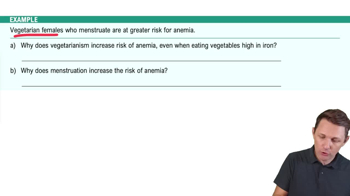
Who is at higher risk for iron deficiency?
Infants, children, and menstruating females, especially vegetarians or vegans, are at higher risk for iron deficiency.
What are some symptoms of iron toxicity?
Iron toxicity can cause digestive symptoms such as nausea, vomiting, diarrhea, and constipation, and in severe cases, organ damage.
What is the tolerable upper limit for iron intake?
The tolerable upper limit for iron is 345 mg per day.
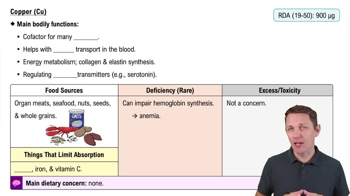
What is the main function of copper in relation to iron?
Copper acts as a cofactor for enzymes involved in iron transport, absorption, and utilization.
What is the RDA for copper for adults aged 19-50?
The RDA for copper is 900 micrograms per day.
Name three good dietary sources of copper.
Organ meats, seafood, and nuts and seeds are good sources of copper.
Which nutrients can decrease copper absorption when consumed in high amounts?
High doses of zinc, iron, and vitamin C can decrease copper absorption.
What can result from a copper deficiency?
Copper deficiency can impair hemoglobin synthesis and lead to anemia.
Is copper toxicity a common dietary concern?
No, copper toxicity is not a common concern and is generally not something to worry about with a normal diet.
 BackBack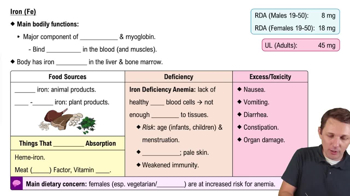
 05:30
05:30