Skip to main content
Nutrition
My Course
Learn
Exam Prep
AI Tutor
Study Guides
Flashcards
Try the app
My Course
Learn
Exam Prep
AI Tutor
Study Guides
Flashcards
Try the app
Back
Water-Soluble Vitamins exam
You can tap to flip the card.
What are water-soluble vitamins?
You can tap to flip the card.
👆
What are water-soluble vitamins?
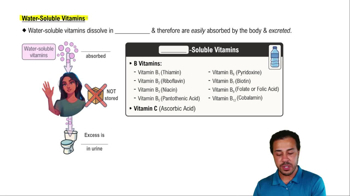
Vitamins that dissolve easily in water, are readily absorbed, and are not stored in large amounts in the body.
Track progress
Control buttons has been changed to "navigation" mode.
1/29
Related flashcards
Related practice
Recommended videos
Water-Soluble Vitamins definitions
Water-Soluble Vitamins
16 Terms
Water-Soluble Vitamins quiz
Water-Soluble Vitamins
15 Terms
Water-Soluble Vitamins quiz #1
Water-Soluble Vitamins
14 Terms
Water-Soluble Vitamins
7. Vitamins
10 problems
Topic
Dietary Guidelines for Vitamins
7. Vitamins
10 problems
Topic
7. Vitamins
5 topics
15 problems
Chapter
Guided course
02:37
Water-Soluble Vitamins Example 1
277
views
3
rank
Guided course
01:09
Water-Soluble Vitamins
372
views
4
rank
01:59
Water-Soluble Vitamins Example 4
203
views
3
rank
Terms in this set (29)
Hide definitions
What are water-soluble vitamins?
Vitamins that dissolve easily in water, are readily absorbed, and are not stored in large amounts in the body.
Vitamin B1 (Thiamine)
A B vitamin important for carbohydrate metabolism and nerve function; deficiency causes beriberi.
What is the main function of B vitamins?
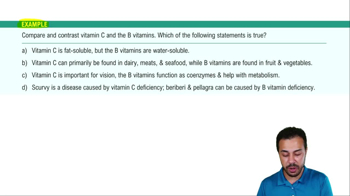
They act as coenzymes or precursors to coenzymes essential for metabolism.
Vitamin C (Ascorbic Acid)
A water-soluble vitamin that acts as a coenzyme and antioxidant, crucial for collagen synthesis and immune health.
How are excess water-soluble vitamins excreted?
They are typically excreted in the urine.
Vitamin B2 (Riboflavin)
A B vitamin required for metabolism of carbohydrates, proteins, and fats; forms the coenzyme FAD.
What disease is caused by thiamine deficiency?
Beriberi, which can affect the cardiovascular or nervous system.
Vitamin B3 (Niacin)
A B vitamin important for energy metabolism, forms NAD+ and NADP+, and helps regulate cholesterol.
What is the main symptom of niacin deficiency?
Pellagra, characterized by dermatitis, dementia, diarrhea, and death.
Vitamin B5 (Pantothenic Acid)
A B vitamin that is a component of coenzyme A, required for fatty acid synthesis and metabolism.
Which B vitamin is effectively stored in the body?
Vitamin B12 (Cobalamin), mainly stored in the liver.
Vitamin B6 (Pyridoxine)
A B vitamin critical for protein metabolism, amino acid synthesis, and hemoglobin production.
What are common symptoms of riboflavin deficiency?
Sore throat, swollen mouth and tongue, dry and cracked lips.
Vitamin B7 (Biotin)
A B vitamin important as a coenzyme in carbohydrate, fat, and protein metabolism.
What is the difference between folate and folic acid?
Folate is the natural form in foods; folic acid is the synthetic form in supplements and fortified foods.
Vitamin B9 (Folate/Folic Acid)
A B vitamin vital for DNA synthesis and reducing neural tube defects during pregnancy.
What can a deficiency in vitamin B12 cause?
Macrocytic anemia and neurological issues.
Vitamin B12 (Cobalamin)
A B vitamin critical for red blood cell production and DNA synthesis; found mainly in animal products.
What is scurvy?
A disease caused by vitamin C deficiency, marked by bleeding gums, poor wound healing, and skin rash.
What foods are rich in vitamin C?
Citrus fruits, tomatoes, peppers, broccoli, and sweet potatoes.
What is a coenzyme?
A vitamin-derived molecule needed to activate certain enzymes.
What is the main function of vitamin C?
Acts as a coenzyme in collagen synthesis and supports immune health.
What population is at higher risk for vitamin B12 deficiency?
Vegans and older adults.
What are symptoms of biotin deficiency?
Hair loss, skin inflammation, and lethargy.
What is macrocytic anemia?
A condition with abnormally large red blood cells, often due to folate or B12 deficiency.
What is the role of B vitamins in energy metabolism?
They help activate enzymes that convert carbohydrates, fats, and proteins into usable energy.
What are the two forms of beriberi?
One affects the cardiovascular system, the other affects the nervous system.
What is the function of pantothenic acid?
Required for fatty acid synthesis and metabolism of carbohydrates, fats, and proteins.
What is the main risk of folate deficiency during pregnancy?
Increased risk of neural tube defects in the fetus.
 BackBack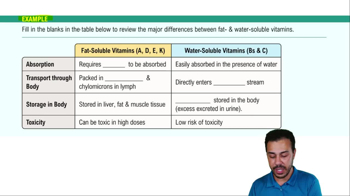
 02:37
02:37