Skip to main content
Nutrition
My Course
Learn
Exam Prep
AI Tutor
Study Guides
Flashcards
Try the app
My Course
Learn
Exam Prep
AI Tutor
Study Guides
Flashcards
Try the app
Back
Why Do We Need Carbohydrates? exam
You can tap to flip the card.
What percentage of daily energy intake should come from carbohydrates according to the AMDR?
You can tap to flip the card.
👆
What percentage of daily energy intake should come from carbohydrates according to the AMDR?
45-65% of daily energy intake should come from carbohydrates.
Track progress
Control buttons has been changed to "navigation" mode.
1/29
Related flashcards
Related practice
Recommended videos
Why Do We Need Carbohydrates? definitions
Why Do We Need Carbohydrates?
15 Terms
Why Do We Need Carbohydrates? quiz
Why Do We Need Carbohydrates?
15 Terms
Why Do We Need Carbohydrates?
4. Carbohydrates
10 problems
Topic
Fiber
4. Carbohydrates
10 problems
Topic
4. Carbohydrates
9 topics
15 problems
Chapter
Guided course
01:59
Why Do We Need Carbohydrates? Example 2
296
views
6
rank
Guided course
03:23
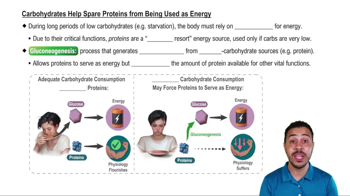
Carbohydrates Help Space Proteins from Being Used as Energy
322
views
8
rank
Guided course
03:44
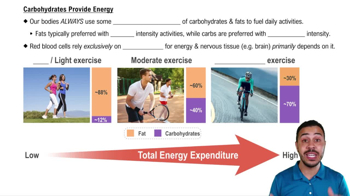
Carbohydrates Provide Energy
367
views
10
rank
Terms in this set (29)
Hide definitions
What percentage of daily energy intake should come from carbohydrates according to the AMDR?
45-65% of daily energy intake should come from carbohydrates.
Ketoacidosis
A dangerous condition where excessive ketone production lowers blood pH, making it too acidic.
Why are carbohydrates considered a preferred energy source during high-intensity exercise?
Because their breakdown is quick and can occur without oxygen, providing rapid energy.
Gluconeogenesis
The process of generating glucose from non-carbohydrate sources, such as proteins.
What is the main energy source for red blood cells?
Glucose is the exclusive energy source for red blood cells.
Acceptable Macronutrient Distribution Range (AMDR)
A guideline recommending the percentage of daily calories that should come from each macronutrient.
How do carbohydrates help prevent ketoacidosis?
By providing enough glucose, they reduce the need for ketone production from fat breakdown.
What happens to protein use in the body when carbohydrate intake is very low?
Proteins are used for energy, reducing their availability for vital functions.
Ketosis
A normal physiological state where the body breaks down fat into ketones for energy when carbohydrates are low.
Why is it important to spare proteins from being used as an energy source?
Proteins are needed for critical functions like making enzymes, hormones, and antibodies.
What is the primary energy source for the brain under normal conditions?
Glucose is the primary energy source for the brain.
How does exercise intensity affect the body's use of carbohydrates and fats for energy?
Higher intensity increases carbohydrate use; lower intensity favors fat use.
Carbohydrates
Essential macronutrients that provide quick energy and support various bodily functions.
What is the effect of excessive ketone accumulation in the blood?
It can lower blood pH, leading to ketoacidosis.
Why can't you lose significant weight by burning fat while at rest?
Because total energy expenditure is low, so the absolute amount of fat burned is small.
What is the role of carbohydrates in protein sparing?
They provide energy so proteins can be used for their primary functions instead of energy.
What happens to blood pH during ketoacidosis?
Blood pH decreases, becoming more acidic.
Why do nutrition experts recommend a high percentage of carbohydrates in the diet?
Because carbohydrates are a major energy source and support overall health.
What alternative fuel can the brain use when glucose is low?
Ketones can serve as an alternative fuel for the brain.
What is the main difference between fat and carbohydrate metabolism during exercise?
Fat metabolism is slower and requires oxygen; carbohydrate metabolism is faster and can occur without oxygen.
How do carbohydrates contribute to energy balance?
They provide a readily available source of energy, especially during high activity.
What is the consequence of prolonged low carbohydrate intake on body proteins?
Proteins are broken down for energy, reducing their availability for other functions.
Why are carbohydrates essential for red blood cell function?
Red blood cells rely exclusively on glucose for energy.
What is the AMDR for carbohydrates?
45-65% of total daily energy intake.
How do carbohydrates help maintain normal blood pH?
By preventing excessive ketone production, they help keep blood pH within normal range.
What is the impact of low carbohydrate diets on the body's energy sources?
The body increases fat and protein breakdown for energy, leading to ketosis and possible protein loss.
What is the preferred energy source for the body at rest?
Fats are the preferred energy source at rest or during low-intensity activity.
How do carbohydrates support overall health?
They provide energy, prevent ketoacidosis, spare proteins, and offer health benefits, especially as fiber.
What is the relationship between exercise intensity and carbohydrate use?
As exercise intensity increases, the body relies more on carbohydrates for energy.
 BackBack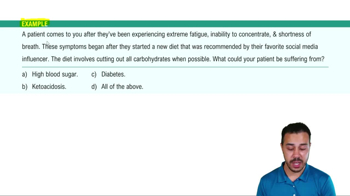
 01:59
01:59