Back

A-Values quiz

Control buttons has been changed to "navigation" mode.
1/15
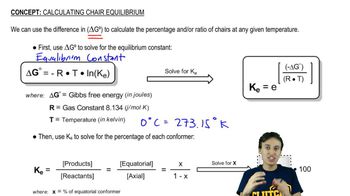
  • What is the formula for calculating the change in free energy (delta G) using the equilibrium constant (KE)?

    Delta G = -RT ln(KE), where R is the gas constant and T is the temperature in Kelvin.
  • What value is used for the gas constant (R) in the delta G equation for these problems?

    The gas constant R is 8.314 J/mol·K.
  • How do you convert Celsius to Kelvin for temperature in these calculations?

    Add 273.15 to the Celsius temperature to convert it to Kelvin.
  • What does the equilibrium constant (KE) represent in the context of cyclohexane conformations?

    KE represents the ratio of the more favored conformation (product) to the less favored conformation (reactant).
  • How is KE calculated from delta G, R, and T?

    KE = e^(-delta G / (RT)).
  • If delta G is positive, what does this indicate about the favored conformation?

    A positive delta G means the equilibrium favors the more stable conformation, resulting in KE greater than 1.
  • What is the formula for calculating the percentage of the favored conformation (x) from KE?

    x = KE / (KE + 1), and to get the percentage, multiply by 100.
  • When using A-values, what does a positive delta G correspond to?

    A positive delta G corresponds to the energy difference when moving to the less stable (axial) conformation.
  • In the context of these calculations, which conformation is typically considered the 'product'?

    The more favored (usually equatorial) conformation is considered the product.
  • What does a KE value greater than 1 indicate about the equilibrium?

    It indicates that the equilibrium favors the product (more stable conformation) over the reactant.
  • How do you find the percentage of the less favored conformation once you have the percentage of the favored one?

    Subtract the percentage of the favored conformation from 100%.
  • Why is it important to use temperature in Kelvin in these calculations?

    Because the gas constant R is defined for Kelvin, and using Celsius would give incorrect results.
  • What should you memorize for exams regarding these calculations?

    You should memorize the delta G equation, the definition of KE, and the formula for calculating x (percentage).
  • What is the significance of the natural logarithm (ln) in the delta G equation?

    The natural logarithm relates the equilibrium constant to the free energy change, allowing calculation of one from the other.
  • How are A-values used in determining cyclohexane conformer percentages?

    A-values provide the delta G (free energy difference) needed to calculate the equilibrium constant and thus the conformer percentages.