Skip to main content
Organic Chemistry
My Course
Learn
Exam Prep
AI Tutor
Study Guides
Textbook Solutions
Flashcards
Explore
Try the app
My Course
Learn
Exam Prep
AI Tutor
Study Guides
Textbook Solutions
Flashcards
Explore
Try the app
Back
Acid-Base Catalysis definitions
You can tap to flip the card.
Acid Catalyst
You can tap to flip the card.
👆
Acid Catalyst
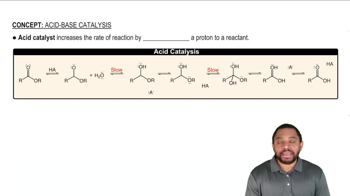
Substance that donates a proton to a reactant, increasing reaction rate by making intermediates more susceptible to nucleophilic attack.
Track progress
Control buttons has been changed to "navigation" mode.
1/14
Related flashcards
Related practice
Recommended videos
Acid-Base Catalysis quiz
Acid-Base Catalysis
15 Terms
Acid-Base Catalysis
31. Catalysis in Organic Reactions
5 problems
Topic
Nucleophilic Catalysis
31. Catalysis in Organic Reactions
5 problems
Topic
31. Catalysis in Organic Reactions - Part 1 of 2
4 topics
12 problems
Chapter
31. Catalysis in Organic Reactions - Part 2 of 2
4 topics
12 problems
Chapter
Guided course
1:06
Acid-Base Catalysis Concept 2
535
views
Guided course
2:50
Acid-Base Catalysis Concept 3
546
views
Guided course
2:30
Acid-Base Catalysis Concept 1
566
views
1
rank
Terms in this set (14)
Hide definitions
Acid Catalyst
Substance that donates a proton to a reactant, increasing reaction rate by making intermediates more susceptible to nucleophilic attack.
Base Catalyst
Substance that removes a proton from a reactant, generating a negatively charged intermediate that can react with electrophiles.
Carbocation
Positively charged carbon intermediate formed after protonation, highly reactive toward nucleophiles.
Nucleophile
Species with a lone pair or negative charge that attacks electron-deficient centers during reactions.
Ester
Carboxylic acid derivative that can be converted back to a carboxylic acid via acid-catalyzed hydrolysis.
Carboxylic Acid
Compound formed from ester hydrolysis, characterized by a carbonyl and hydroxyl group on the same carbon.
Alpha Carbon
Carbon atom directly adjacent to a carbonyl group, often the site of deprotonation in base-catalyzed reactions.
Enolate Ion
Negatively charged intermediate formed after deprotonation of an alpha carbon, capable of nucleophilic attack.
Alkyl Halide
Organic molecule containing a halogen atom bonded to an alkyl group, often used as an electrophile in alkylation.
Alkylation Reaction
Process where an alkyl group is introduced to a molecule, typically at the alpha carbon via nucleophilic attack.
Specific Catalysis
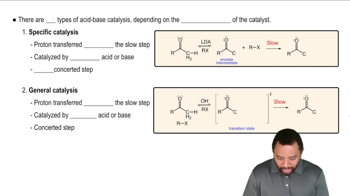
Mechanism where proton transfer occurs before the slow step, usually involving strong acids or bases in non-concerted steps.
General Catalysis
Mechanism where proton transfer occurs during the slow step, typically with weak acids or bases in a concerted process.
Transition State
High-energy, short-lived configuration where bonds are simultaneously breaking and forming during a reaction.
Leaving Group
Atom or group that departs with a pair of electrons during a reaction, facilitating bond formation elsewhere.
 BackBack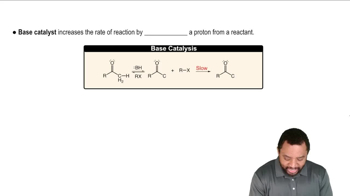
 1:06
1:06