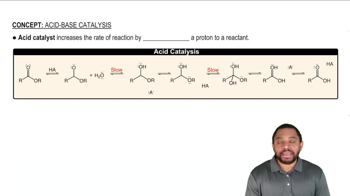
How does an acid catalyst increase the rate of a reaction?
An acid catalyst donates a proton (H+) to a reactant, making it more susceptible to nucleophilic attack and speeding up the reaction.
What intermediate is formed when an acid catalyst acts on an ester?
A carbocation intermediate is formed, which is then attacked by a nucleophile such as water.
What role does water play in acid-catalyzed ester hydrolysis?
Water acts as a nucleophile, attacking the carbocation intermediate to eventually form a carboxylic acid.
Why is protonation of the alkoxy group important in acid-catalyzed reactions?
Protonation makes the alkoxy group a better leaving group, facilitating its departure and the formation of the carboxylic acid.
How does a base catalyst increase the rate of a reaction?
A base catalyst removes a proton from a reactant, often generating a negatively charged intermediate like an enolate ion.
What is the significance of the alpha carbon in base-catalyzed reactions?
The alpha carbon, adjacent to a carbonyl, is weakly acidic and can be deprotonated by a base to form a reactive enolate ion.
What is an alkylation reaction in the context of base catalysis?
An alkylation reaction involves the enolate ion attacking an alkyl halide, adding a carbon group to the alpha carbon.
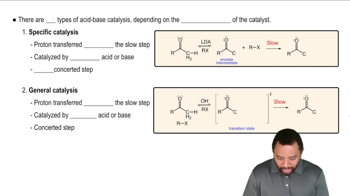
What is the difference between specific and general acid-base catalysis?
Specific catalysis involves proton transfer before the slow step with strong acids or bases, while general catalysis involves proton transfer during the slow step with weak acids or bases.
In specific catalysis, when does proton transfer occur?
Proton transfer occurs before the slow (rate-determining) step in specific catalysis.
What type of acid or base is used in general catalysis?
General catalysis uses a weak acid or base, and the proton transfer happens during the slow step.
What is a concerted step in general catalysis?
A concerted step means that bond breaking and bond forming occur simultaneously in a single transition state.
What is the role of LDA in specific base catalysis?
LDA, a strong bulky base, deprotonates the alpha carbon to form an enolate intermediate.
How does the mechanism differ between specific and general catalysis?
Specific catalysis is stepwise (non-concerted), while general catalysis is concerted, with all bond changes happening at once.
What is the end result of both specific and general base-catalyzed alkylation reactions?
Both result in the alkylation of the alpha carbon, adding an alkyl group to it.
Why is understanding acid-base catalysis important in organic chemistry?
It helps predict reaction mechanisms and efficiency, as the type of catalysis influences how and how fast reactions proceed.
 Back
Back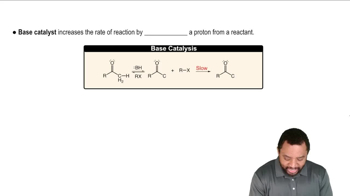
 1:06
1:06