Back

Acid-Catalyzed Hydration definitions

Control buttons has been changed to "navigation" mode.
1/14
  • Acid-Catalyzed Hydration

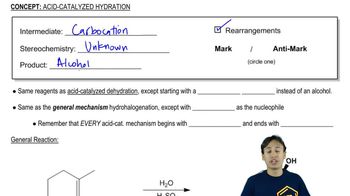
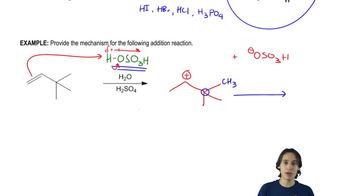
    A reaction adding water and acid to a double bond, producing alcohols via a carbocation intermediate.
  • Carbocation

    A planar, positively charged intermediate prone to rearrangements and unpredictable stereochemistry.
  • Rearrangement

    A process where an intermediate changes structure, often leading to unexpected products.
  • Markovnikov Alcohol

    A product where the OH group attaches to the more substituted carbon of the original double bond.
  • Double Bond

    A region of high electron density in alkenes that serves as the site for addition reactions.
  • Protonation

    The initial step where a proton is added to a molecule, activating it for further reaction.
  • Deprotonation

    The final step where a proton is removed, regenerating the acid catalyst in the reaction.
  • Nucleophile

    A species, such as water in this reaction, that donates an electron pair to form a new bond.
  • Chiral Center

    A carbon atom bonded to four different groups, leading to possible stereoisomers.
  • Stereochemistry

    The spatial arrangement of atoms in products, often unpredictable due to planar intermediates.
  • Squiggly Line

    A notation in structures indicating unknown or mixed stereochemistry at a specific position.
  • Hydration

    The addition of water across a double bond, resulting in an alcohol.
  • Catalyst

    A substance, such as an acid, that speeds up a reaction without being consumed.
  • Hydrohalogenation

    A related addition reaction where a hydrogen halide adds across a double bond, following a similar mechanism.