Control buttons has been changed to "navigation" mode.
1/19
Terms in this set (19)
How can you determine which hydrogen atom in a molecule is the most acidic?
The most acidic hydrogen atom is typically attached to the atom or group that can best stabilize the resulting negative charge after deprotonation, such as a hydrogen on a carboxylic acid group or near electronegative atoms.
How do you determine which species in a pair is the stronger base?
The stronger base is the one more likely to accept a proton, often the species with a higher electron density or less stabilized negative charge.
How do you identify the most acidic hydrogen atom in a molecule like vitamin C (ascorbic acid)?
The most acidic hydrogen in a molecule like vitamin C is typically the one attached to an oxygen atom in a carboxylic acid or enol group, where the resulting negative charge can be stabilized by resonance.
What characteristics make a base ineffective for deprotonating a terminal alkyne?
A base is ineffective for deprotonating a terminal alkyne if it is not strong enough to remove the relatively acidic hydrogen, meaning its conjugate acid has a higher pKa than the terminal alkyne.
What is the chemical formula for the conjugate acid of trimethylamine ((CH3)3N)?
The chemical formula for the conjugate acid of trimethylamine is (CH3)3NH+.
How do you determine which indicated proton in a molecule is most acidic?
The most acidic proton is the one whose removal leads to the most stable conjugate base, often due to resonance stabilization or proximity to electronegative atoms.
What factors make a species more likely to react as a base rather than a nucleophile?
A species is more likely to react as a base rather than a nucleophile if it is bulky or if the reaction conditions favor proton transfer over bond formation with carbon.
Will acetone be completely deprotonated by potassium tert-butoxide?
Acetone will not be completely deprotonated by potassium tert-butoxide because tert-butoxide is not a strong enough base to fully remove the relatively non-acidic hydrogen from acetone.
What is the formula of the conjugate acid of the acetate ion (CH3COO−)?
The formula of the conjugate acid of the acetate ion (CH3COO−) is acetic acid (CH3COOH).
How do you select the most acidic hydrogen in a molecule?
The most acidic hydrogen is typically the one attached to an atom that, when deprotonated, results in a conjugate base stabilized by resonance or electronegative atoms.
Is methylamine (CH3NH2) an acid or a base?
Methylamine (CH3NH2) is a base because it can accept a proton.
How do you arrange carboxylic acids in order of acidity?
Carboxylic acids are arranged in order of acidity based on the stability of their conjugate bases; acids with more electron-withdrawing groups or resonance stabilization are more acidic.
How do you convert a molecule into its Brønsted-Lowry conjugate acid?
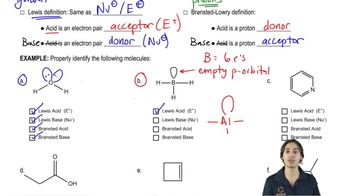
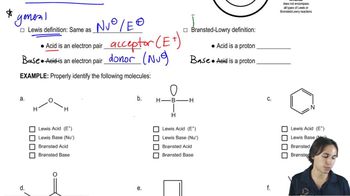
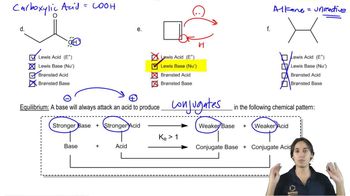
To convert a molecule into its Brønsted-Lowry conjugate acid, add a proton (H+) to the site with a lone pair or negative charge.
How do you draw the conjugate acid for a given base?
To draw the conjugate acid of a base, add a proton (H+) to the atom with a lone pair or negative charge.
How do you rank active methylene compounds in order of decreasing acid strength?
Active methylene compounds are ranked in order of decreasing acid strength based on the ability of adjacent groups to stabilize the negative charge on the conjugate base, such as through resonance or inductive effects.
What is the conjugate acid of ethanol (CH3CH2OH)?
The conjugate acid of ethanol (CH3CH2OH) is the ethyloxonium ion (CH3CH2OH2+).
What is the conjugate acid of ammonia (NH3)?
The conjugate acid of ammonia (NH3) is ammonium (NH4+).
How do you draw the conjugate base for the acid (CH3)2C=OH+?
To draw the conjugate base of (CH3)2C=OH+, remove a proton (H+) from the oxygen, resulting in (CH3)2C=O.
How do you modify a structure to draw its conjugate acid?
To draw the conjugate acid of a structure, add a proton (H+) to the atom with a lone pair or negative charge.