Back

Alcohol Protecting Groups quiz

Control buttons has been changed to "navigation" mode.
1/15
  • What is the main purpose of a protecting group in organic synthesis?

    A protecting group is used to shield a reactive region (moiety) of a molecule from reactions occurring elsewhere, allowing selective reactions to take place.
  • When is it necessary to use a protecting group in a molecule?

    Protecting groups are necessary when a molecule contains more than one functional group and selective reaction with one group is desired.
  • Why must the reaction involving a protecting group be reversible?

    The reaction must be reversible so that the original functional group can be regenerated after the desired reaction is complete.
  • What is a moiety in the context of protecting groups?

    A moiety refers to a reactive region or functional group within a molecule that may need to be protected during a reaction.
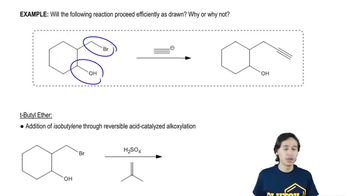
  • What problem arises when an alkynide is used with a molecule containing both an alcohol and an alkyl halide?

    The alkynide, being a strong base, will react with the alcohol's acidic proton via an acid-base mechanism, interfering with the desired substitution reaction on the alkyl halide.
  • How do alkynides typically react with alcohols?

    Alkynides react with alcohols through an acid-base mechanism because alcohols have an acidic proton and alkynides are strong bases.
  • What type of reaction is desired between an alkynide and an alkyl halide?

    The desired reaction is an SN2 substitution reaction between the alkynide and the alkyl halide.
  • Why might a reaction not proceed to completion when both an alcohol and an alkyl halide are present with an alkynide?

    The alkynide will preferentially react with the alcohol rather than the alkyl halide, preventing the desired substitution reaction from occurring.
  • What is the general strategy for using a protecting group with alcohols?

    The strategy is to temporarily deactivate the alcohol with a protecting group, perform the desired reaction, and then remove the protecting group to regenerate the alcohol.
  • What happens to the alcohol after the protecting group is removed?

    After the protecting group is removed, the original alcohol functional group is regenerated in the molecule.
  • Can you use a protecting group if there is only one functional group in the molecule?

    No, protecting groups are only used when there is more than one functional group and selective reactivity is needed.
  • What is the main issue with alcohols in multi-functional group reactions?

    Alcohols can interfere with reactions by reacting with strong bases or nucleophiles, such as alkynides, through acid-base mechanisms.
  • What is the benefit of using a protecting group in organic synthesis?

    Using a protecting group allows chemists to control which functional group reacts, improving the selectivity and yield of the desired product.
  • What must be true about the removal of a protecting group?

    The removal must be easy and must restore the original functional group without damaging the rest of the molecule.
  • Why did scientists develop protecting groups for alcohols?

    Scientists developed protecting groups for alcohols to prevent them from interfering with other reactions, such as nucleophilic substitutions, by temporarily deactivating them.