Back

Alcohol Synthesis definitions

Control buttons has been changed to "navigation" mode.
1/15
  • Oxymercuration-Reduction

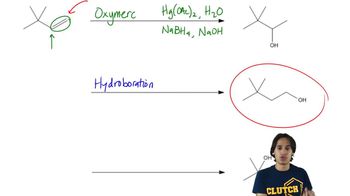
    A two-step process adding a hydroxyl to the Markovnikov position of a double bond without carbocation rearrangement, using mercury(II) acetate, water, NaBH4, and base.
  • Hydroboration-Oxidation

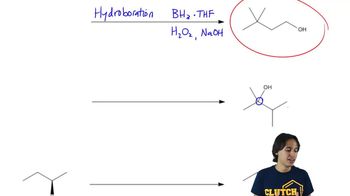
    A method for installing a hydroxyl at the least substituted position of a double bond, using boron reagents followed by oxidation with hydrogen peroxide and base.
  • Markovnikov Position

    The more substituted carbon of a double bond, where electrophilic addition typically occurs, leading to the most stable carbocation or product.
  • Anti-Markovnikov Addition

    A regioselective process where a group attaches to the less substituted carbon of a double bond, opposite to Markovnikov's rule.
  • Carbocation Intermediate

    A positively charged carbon species formed during some addition reactions, prone to rearrangement for increased stability.
  • Acid-Catalyzed Hydration

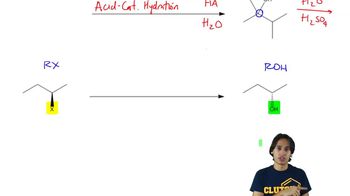
    A reaction using strong acid and water to add a hydroxyl to the most stable position of a double bond, proceeding via a carbocation.
  • Alkyl Halide

    An organic molecule containing a halogen atom bonded to an sp3-hybridized carbon, serving as a substrate in substitution reactions.
  • SN2 Reaction

    A bimolecular nucleophilic substitution where a nucleophile attacks from the backside, inverting stereochemistry, effective for primary or secondary alkyl halides.
  • Nucleophile

    A species with a lone pair or negative charge that seeks out electrophilic centers, such as NaOH in substitution reactions.
  • Stereochemistry

    The spatial arrangement of atoms in molecules, crucial in reactions like SN2 where inversion occurs.
  • Hydroxyl Group

    A functional group consisting of an oxygen and hydrogen atom, characteristic of alcohols and introduced via various addition reactions.
  • Reduction

    A reaction step involving the gain of electrons or hydrogen, such as converting a mercury intermediate to an alcohol in oxymercuration.
  • Base

    A substance that accepts protons or donates electron pairs, often used in the oxidation or reduction steps of alcohol synthesis.
  • Rearrangement

    A process where atoms or groups shift within a molecule, often occurring with carbocation intermediates to form more stable structures.
  • THF

    A common solvent, tetrahydrofuran, often used to stabilize boron reagents in hydroboration reactions.