Back

Alcohol Synthesis quiz

Control buttons has been changed to "navigation" mode.
1/15
  • What is the key feature of oxymercuration-reduction in alcohol synthesis?

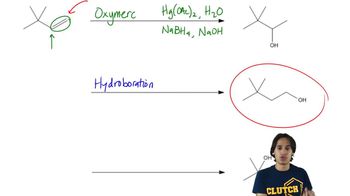
    Oxymercuration-reduction adds a hydroxyl group to the Markovnikov (more substituted) position of a double bond without forming a carbocation intermediate.
  • Which reagents are used in oxymercuration-reduction to synthesize alcohols?

    The reagents are Hg(OAc)2 and water for oxymercuration, followed by NaBH4 and NaOH for reduction.
  • Why does oxymercuration-reduction avoid carbocation rearrangement?

    Because it does not form a carbocation intermediate, preventing possible shifts and rearrangements.
  • What is the main difference between hydroboration-oxidation and oxymercuration-reduction in alcohol addition?

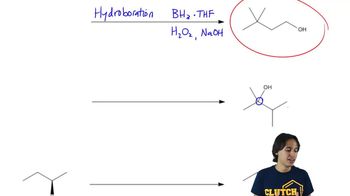
    Hydroboration-oxidation adds the hydroxyl group to the least substituted (anti-Markovnikov) position, while oxymercuration-reduction adds it to the most substituted (Markovnikov) position.
  • What reagents are used in hydroboration-oxidation for alcohol synthesis?

    BH3 (often with THF) is used for hydroboration, followed by hydrogen peroxide and a base for oxidation.
  • What is the role of THF in hydroboration-oxidation?

    THF acts as a solvent and can complex with BH3, but its presence is not strictly required.
  • Which reaction adds an alcohol to the most stable (tertiary) position of a double bond?

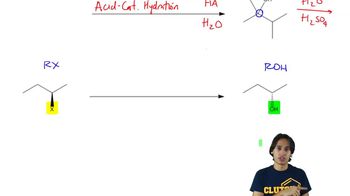
    Acid-catalyzed hydration adds the hydroxyl group to the most stable, often tertiary, position via a carbocation intermediate.
  • What are the typical reagents for acid-catalyzed hydration?

    Sulfuric acid (H2SO4) and water (H2O) are commonly used.
  • Why does acid-catalyzed hydration often result in alcohol at the tertiary position?

    Because the carbocation intermediate can rearrange to the most stable (tertiary) position before water adds.
  • What type of alkyl halides can undergo SN2 reactions to form alcohols?

    Methyl, primary, and secondary alkyl halides can undergo SN2 reactions, but tertiary alkyl halides cannot due to steric hindrance.
  • What is the nucleophile used in SN2 alcohol synthesis from alkyl halides?

    NaOH is used as the nucleophile to replace the halide with a hydroxyl group.
  • How does SN2 reaction affect the stereochemistry of the product alcohol?

    SN2 reactions invert the stereochemistry at the carbon where substitution occurs.
  • What is the main limitation of SN2 reactions for alcohol synthesis?

    SN2 reactions are not suitable for tertiary alkyl halides due to steric hindrance preventing backside attack.
  • How many common methods are there for synthesizing alcohols discussed in the lesson?

    There are four common methods: oxymercuration-reduction, hydroboration-oxidation, acid-catalyzed hydration, and SN2 substitution.
  • What is the purpose of reviewing alcohol synthesis methods in organic chemistry?

    Reviewing these methods helps understand different mechanisms and conditions for forming alcohols from various starting materials.