Skip to main content
Organic Chemistry
My Course
Learn
Exam Prep
AI Tutor
Study Guides
Textbook Solutions
Flashcards
Explore
Try the app
My Course
Learn
Exam Prep
AI Tutor
Study Guides
Textbook Solutions
Flashcards
Explore
Try the app
Back
Alkane Halogenation quiz
You can tap to flip the card.
What is the only way to functionalize alkanes according to the synthetic cheat sheet?
You can tap to flip the card.
👆
What is the only way to functionalize alkanes according to the synthetic cheat sheet?
The only way to functionalize alkanes is through radical halogenation.
Track progress
Control buttons has been changed to "navigation" mode.
1/15
Related flashcards
Related practice
Recommended videos
Alkane Halogenation definitions
Alkane Halogenation
13 Terms
Alkane Halogenation
14. Synthetic Techniques
1 problem
Topic
Ernest
Retrosynthesis
14. Synthetic Techniques
5 problems
Topic
Nicole
14. Synthetic Techniques
5 topics
13 problems
Chapter
Johnny
02:47
Functionalizing Alkanes
1342
views
3
rank
5
comments
Terms in this set (15)
Hide definitions
What is the only way to functionalize alkanes according to the synthetic cheat sheet?
The only way to functionalize alkanes is through radical halogenation.
Why is radical chlorination only useful when there is a single type of hydrogen in the molecule?
Radical chlorination is only useful with a single type of hydrogen because otherwise, selectivity becomes an issue and undesired products may form.
What reagent and conditions are used to convert an alkane to an alkyl halide in a straightforward manner?
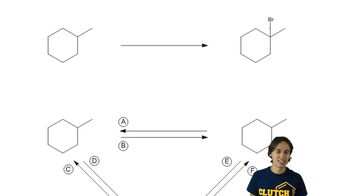
Br2 with heat or light is used to convert an alkane to an alkyl halide.
Why are exam questions about alkane halogenation often more complex than simple one-step reactions?
Exam questions are often more complex to test understanding of multi-step retrosynthesis and functional group placement.
What must students understand besides converting alkanes to alkyl halides?
Students must also understand how to convert alkyl halides back to alkanes.
What is required to place a halogen on a specific carbon of an alkane when direct halogenation is not possible?
Multi-step synthesis is required to place a halogen on a specific carbon when direct halogenation is not feasible.
What is the main challenge in alkane halogenation when the molecule contains different types of hydrogens?
The main challenge is selectivity, as different hydrogens can lead to multiple products.
What is the typical academic expectation for alkane halogenation problems?
Students are expected to solve multi-step retrosynthesis problems rather than simple one-step conversions.
What is the role of Br2 in alkane halogenation?
Br2 acts as the halogen source for radical halogenation, converting alkanes to alkyl bromides.
What should students do before the instructor provides the answer to synthesis problems?
Students should attempt the synthesis on their own by pausing the video and trying to solve the problem.
What is the significance of exercises labeled b and d in the lesson?
Exercises b and d require students to determine reagents for multi-step synthesis to place an alkyl halide at specific positions.
What is the importance of knowing reactions that convert alkyl halides back to alkanes?
It is important for understanding both forward and reverse synthetic transformations in organic chemistry.
Why is direct halogenation not always possible for placing a halogen on a random carbon?
Direct halogenation is not always possible due to lack of selectivity and the need for multi-step synthesis.
What is the instructor's advice for tackling tricky synthesis exercises?
The instructor advises students to concentrate and figure out the necessary reagents for multi-step transformations.
What is the main focus of the alkane halogenation lesson?
The main focus is understanding radical halogenation, retrosynthesis, and multi-step functionalization of alkanes.
 BackBack


 02:47
02:47