Back

Alkene Metathesis quiz

Control buttons has been changed to "navigation" mode.
1/15
  • What is alkene metathesis?

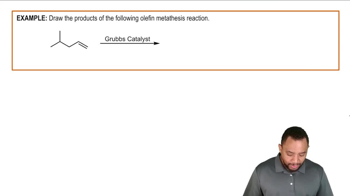
    Alkene metathesis is a reaction where two alkenes exchange carbon atoms from their double bonds, resulting in new alkenes.
  • What catalyst is commonly used in alkene metathesis?

    Grubbs Catalyst, which contains ruthenium, is commonly used in alkene metathesis.
  • What types of isomers are produced in alkene metathesis?

    A mixture of E and Z isomers is produced, depending on the alignment of the R groups.
  • What is the role of ethene gas in alkene metathesis?

    Ethene gas is highly volatile and bubbles out of solution, driving the reaction to completion.
  • What is ring-closing metathesis used for?

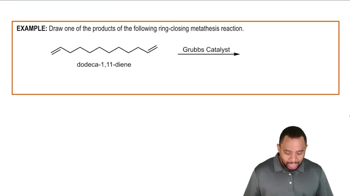
    Ring-closing metathesis is used to synthesize cycloalkenes, especially large rings that are otherwise difficult to make.
  • Why are dilute solutions used in ring-closing metathesis?

    Dilute solutions are used to avoid intermolecular metathesis and favor intramolecular ring formation.
  • How many phases are there in the alkene metathesis mechanism?

    There are two phases: formation of intermediates and their subsequent reaction to yield products.
  • What is a 2+2 cycloaddition in the context of alkene metathesis?

    A 2+2 cycloaddition is a synthetic step that forms a cyclobutane ring between the catalyst and the alkene.
  • What is cycloreversion?

    Cycloreversion is the reverse of cycloaddition, breaking the cyclobutane ring to form intermediates.
  • What happens in step 1a of phase 1 in the mechanism?

    The alkene replaces one of the ligands in the Grubbs catalyst, connecting the alkene to the catalyst.
  • What is formed during step 1b of phase 1?

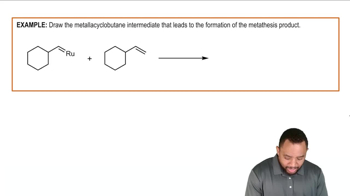
    A metallocyclobutane ring is formed via 2+2 cycloaddition between the alkene and the Grubbs catalyst.
  • What is the outcome of step 1c in phase 1?

    The metallocyclobutane undergoes cycloreversion, producing two intermediates with ruthenium attached to the alkene carbons.
  • What occurs in phase 2 of the mechanism?

    Each intermediate undergoes another cycle of addition and cycloreversion with an alkene, yielding the final products.
  • How are E and Z isomers formed in phase 2?

    E and Z isomers are formed depending on whether the R groups are on the same or opposite sides after the reaction.
  • Why does alkene metathesis give the best yields with terminal alkenes?

    Terminal alkenes produce ethene gas, which escapes from the solution and shifts the equilibrium toward product formation.