Skip to main content
Organic Chemistry
My Course
Learn
Exam Prep
AI Tutor
Study Guides
Textbook Solutions
Flashcards
Explore
Try the app
My Course
Learn
Exam Prep
AI Tutor
Study Guides
Textbook Solutions
Flashcards
Explore
Try the app
Back
Alkene Stability definitions
You can tap to flip the card.
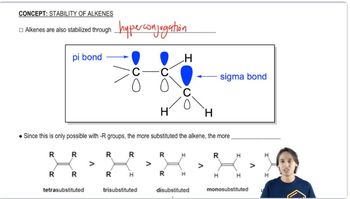
Hyperconjugation
You can tap to flip the card.
👆
Hyperconjugation
Stabilizing effect from adjacent sigma bonds sharing electron density with a pi bond, enhancing double bond stability.
Track progress
Control buttons has been changed to "navigation" mode.
1/14
Related flashcards
Related practice
Recommended videos
Alkene Stability quiz #1
Stability of Alkenes
10 Terms
Alkene Stability
9. Alkenes and Alkynes
7 problems
Topic
Johnny
Zaitsev Rule
9. Alkenes and Alkynes
7 problems
Topic
Johnny
9. Alkenes and Alkynes - Part 1 of 2
5 topics
11 problems
Chapter
Ernest
9. Alkenes and Alkynes - Part 2 of 2
5 topics
11 problems
Chapter
Johnny
02:55
Heat of Combustion
4508
views
53
rank
12
comments
04:28
Understanding trends of alkene stability.
5654
views
42
rank
11
comments
Terms in this set (14)
Hide definitions
Hyperconjugation
Stabilizing effect from adjacent sigma bonds sharing electron density with a pi bond, enhancing double bond stability.
Pi Bond
Electron-rich region formed by overlapping p orbitals, present in double bonds and susceptible to stabilization.
Sigma Bond
Single covalent bond formed by head-on orbital overlap, capable of donating electron density to nearby pi bonds.
Carbocation
Positively charged carbon species stabilized by the same electron-donating effect as alkenes.
R Group
Alkyl or substituent group attached to a molecule, increasing double bond stability through electron donation.
Tetrasubstituted Alkene
Double bond surrounded by four substituent groups, exhibiting maximum stability due to extensive hyperconjugation.
Trisubstituted Alkene
Double bond with three substituent groups, offering high but not maximal stabilization from adjacent groups.
Disubstituted Alkene
Double bond with two substituent groups, displaying intermediate stability and multiple possible arrangements.
Monosubstituted Alkene
Double bond with a single substituent group, allowing limited stabilization from hyperconjugation.
Unsubstituted Alkene
Double bond lacking substituent groups, resulting in minimal stability due to absence of electron donation.
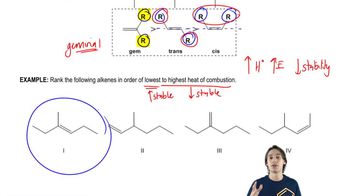
Cis Isomer
Arrangement where two substituent groups are on the same side of a double bond, leading to increased steric strain.
Trans Isomer
Arrangement with substituent groups on opposite sides of a double bond, reducing steric interference and increasing stability.
Geminal Isomer
Configuration where two substituent groups are attached to the same carbon of a double bond, providing highest stability among disubstituted forms.
Steric Interference
Destabilizing effect caused by groups crowding each other in space, especially in certain alkene isomers.
 BackBack

 02:55
02:55