Back

Alkyne Halogenation definitions

Control buttons has been changed to "navigation" mode.
1/12
  • Halogenation

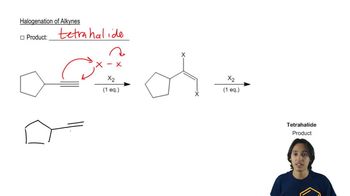
    A reaction where halogen atoms are added across multiple bonds, often resulting in dihalide or tetrahalide products.
  • Alkyne

    A hydrocarbon containing a carbon-carbon triple bond, capable of undergoing addition reactions with halogens.
  • Vicinal Dihalide

    A compound with two halogen atoms attached to adjacent carbons, formed by adding one equivalent of halogen to an alkyne.
  • Tetrahalide

    A molecule featuring four halogen atoms on adjacent carbons, produced by reacting an alkyne with excess halogen.
  • Triple Bond

    A chemical bond involving three shared pairs of electrons, characteristic of alkynes and highly reactive toward addition.
  • Double Bond

    A bond with two shared pairs of electrons, present as an intermediate in alkyne halogenation after the first addition.
  • Bridge Structure

    A cyclic intermediate formed when a halogen atom temporarily connects to both carbons of a multiple bond during addition.
  • Equivalent

    A stoichiometric amount of reagent, with one leading to dihalide and two or more resulting in tetrahalide formation.
  • Markovnikov Position

    The carbon atom in a multiple bond that preferentially receives the halogen during addition, influencing product structure.
  • Pi Bond

    A type of bond formed by sideways overlap of p orbitals, present in double and triple bonds and reactive in halogenation.
  • Excess Halogen

    A condition where more than one equivalent of halogen is present, ensuring complete addition to all available bonds.
  • Hydrogen Atom

    A single proton with one electron, retained at the terminal position of the product after alkyne halogenation.