Back

Alkyne Halogenation quiz

Control buttons has been changed to "navigation" mode.
1/15
  • What is the typical product when an alkyne is reacted with one equivalent of halogen?

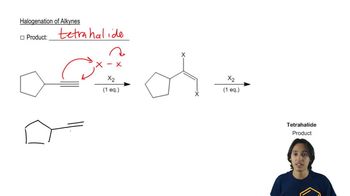
    The typical product is a vicinal dihalide, where two halogen atoms are added to adjacent carbons.
  • What product forms when an alkyne is reacted with excess halogen?

    A tetrahalide is formed, with four halogen atoms added to adjacent carbons.
  • What is the mechanism for halogenation of alkynes?

    The triple or double bond captures a halogen atom, forming a bridge structure, which is then attacked by another halogen atom.
  • What happens to the double bond after the first halogenation of an alkyne?

    The remaining double bond can react again with halogen, leading to further addition.
  • How many halogen atoms are added in total when an alkyne reacts with two equivalents of halogen?

    Four halogen atoms are added, resulting in a tetrahalide.
  • What is retained at the end of the molecule after alkyne halogenation?

    A hydrogen atom from the original alkyne is retained at the end of the molecule.
  • What is a vicinal dihalide?

    A vicinal dihalide is a compound where two halogen atoms are attached to adjacent carbons.
  • What does 'excess halogen' mean in the context of alkyne halogenation?

    It means more than one equivalent of halogen, allowing the reaction to occur twice.
  • What is the role of the pi bond in the halogenation mechanism?

    The pi bond attacks the halogen molecule, initiating the formation of a bridge intermediate.
  • What happens to the bridge structure during halogenation?

    Another halogen atom attacks the bridge, leading to the addition of halogens to the carbons.
  • How does the product differ when only one equivalent of halogen is used versus excess?

    One equivalent gives a vicinal dihalide, while excess gives a tetrahalide.
  • What is the Markovnikov position in alkyne halogenation?

    It is the position where the second halogen atom attaches during the mechanism, following Markovnikov's rule.
  • How many times does the halogenation reaction occur with excess halogen?

    The reaction occurs twice, once for each pi bond in the alkyne.
  • What is the final structure of a tetrahalide formed from alkyne halogenation?

    The final structure has four halogen atoms attached to two adjacent carbons, with a terminal hydrogen.
  • Why is alkyne halogenation not considered a difficult reaction?

    Because the mechanism is straightforward and involves simple addition steps.