Back

Alkyne Hydration definitions

Control buttons has been changed to "navigation" mode.
1/14
  • Triple Bond

    A region in a molecule where three pairs of electrons are shared between two atoms, often found in alkynes.
  • Vinyl Alcohol

    A compound featuring an alcohol group directly attached to a carbon-carbon double bond, acting as a key intermediate.
  • Tautomerization

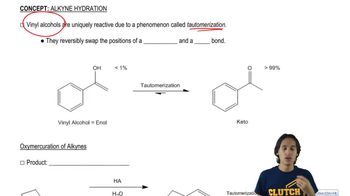
    A reversible process where a hydrogen and a pi bond exchange positions, converting an enol to a more stable carbonyl compound.
  • Enol

    An intermediate with an alcohol group bonded to an alkene, which rapidly rearranges to a more stable structure.
  • Keto Form

    The favored product after tautomerization, characterized by a carbonyl group such as a ketone or aldehyde.
  • Ketone

    A compound with a carbonyl group bonded to two carbon atoms, commonly formed after hydration of alkynes.
  • Aldehyde

    A molecule containing a carbonyl group bonded to at least one hydrogen, sometimes produced from terminal alkyne hydration.
  • Oxymercuration

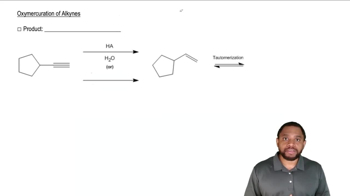
    A reaction method that adds water across a multiple bond, favoring Markovnikov addition and leading to enol intermediates.
  • Acid-Catalyzed Hydration

    A process using acid and water to add an alcohol group to the more substituted carbon of a triple bond.
  • Markovnikov Addition

    A regioselective process where a group attaches to the more substituted carbon during a chemical reaction.
  • Intermediate

    A transient species formed during a reaction, such as an enol, which quickly converts to a more stable product.
  • Carbonyl Group

    A functional group featuring a carbon double-bonded to oxygen, central to ketones and aldehydes.
  • Equilibrium

    A dynamic state where forward and reverse reactions occur at equal rates, often favoring the keto form in tautomerization.
  • Hydration

    A chemical process where water is added to a molecule, transforming alkynes into alcohols and subsequently into carbonyl compounds.