Back

Alkyne Hydroboration definitions

Control buttons has been changed to "navigation" mode.
1/14
  • Hydroboration

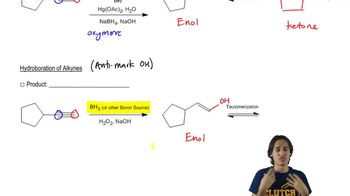
    A reaction introducing a boron atom and hydrogen across a multiple bond, favoring the less substituted carbon.
  • Anti-Markovnikov Addition

    A regioselective process where a group attaches to the less substituted carbon of a double or triple bond.
  • Enol

    A compound featuring a hydroxyl group bonded to a carbon-carbon double bond, often as an intermediate.
  • Tautomerism

    A dynamic equilibrium between two isomers, typically involving relocation of a proton and a double bond.
  • Keto Form

    A structure with a carbonyl group, often more stable than its enol counterpart in equilibrium.
  • Aldehyde

    A molecule with a terminal carbonyl group bonded to at least one hydrogen, often formed from terminal alkynes.
  • Ketone

    A compound with a carbonyl group bonded to two carbons, typically resulting from Markovnikov hydration.
  • Regioselectivity

    A preference for bond formation at one direction or position over others in a chemical reaction.
  • BH3

    A boron-containing reagent commonly used to initiate hydroboration by adding across unsaturated bonds.
  • Oxidation

    A step converting a boron-containing intermediate into an alcohol or carbonyl compound.
  • Vinyl Alcohol

    An enol with a hydroxyl group directly attached to a carbon-carbon double bond.
  • Terminal Carbonyl

    A carbonyl group located at the end of a carbon chain, characteristic of aldehydes.
  • Markovnikov Hydration

    A process where water adds to the more substituted carbon, typically yielding a ketone.
  • Oxymercuration-Demercuration

    A two-step method for adding water to alkenes with Markovnikov selectivity, avoiding carbocation rearrangement.