Back

Alkyne Hydroboration quiz

Control buttons has been changed to "navigation" mode.
1/15
  • What type of regioselectivity does hydroboration-oxidation exhibit when adding alcohol to an alkene or alkyne?

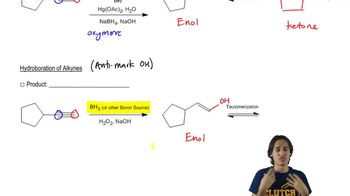
    Hydroboration-oxidation exhibits anti-Markovnikov regioselectivity, adding the alcohol to the less substituted carbon.
  • Which carbon does the hydroxyl group add to during hydroboration-oxidation?

    The hydroxyl group adds to the less substituted carbon atom.
  • What intermediate is formed after the hydroboration step before oxidation?

    An enol (vinyl alcohol) intermediate is formed.
  • What does the enol intermediate tautomerize into after hydroboration-oxidation?

    The enol tautomerizes into a keto form, often yielding an aldehyde if the carbonyl is terminal.
  • What is the final product when hydroboration-oxidation is performed on a terminal alkyne?

    The final product is an aldehyde.
  • What is the final product when Markovnikov hydration is performed on an alkyne?

    The final product is a ketone.
  • What is the role of BH3 in hydroboration-oxidation?

    BH3 acts as the boron source that adds across the triple bond in the first step.
  • Why is it important to know which boron reagent your professor uses in hydroboration-oxidation?

    Different boron sources can be used, so you need to recognize the one your professor prefers for the reaction.
  • What happens to the position of the double bond and hydrogen during tautomerization after hydroboration-oxidation?

    The double bond shifts and a hydrogen transfers, converting the enol to a carbonyl group.
  • What distinguishes an aldehyde from a ketone in the context of hydroboration-oxidation products?

    An aldehyde has a carbonyl group at the terminal position with a hydrogen attached, while a ketone has the carbonyl within the chain.
  • What is the significance of tautomerism in hydroboration-oxidation?

    Tautomerism allows the enol intermediate to convert into the more stable keto (aldehyde or ketone) form.
  • How does the regiochemistry of hydroboration-oxidation compare to oxymercuration-demercuration?

    Hydroboration-oxidation gives the opposite regioselectivity, adding to the less substituted carbon.
  • What is the general outcome of anti-Markovnikov addition of water to an alkyne?

    It leads to the formation of an enol, which tautomerizes to an aldehyde.
  • What is the general outcome of Markovnikov addition of water to an alkyne?

    It leads to the formation of a ketone.
  • Why is understanding the mechanism of hydroboration-oxidation important in organic synthesis?

    It is crucial for synthesizing aldehydes and ketones with specific regioselectivity.