Skip to main content
Organic Chemistry
My Course
Learn
Exam Prep
AI Tutor
Study Guides
Textbook Solutions
Flashcards
Explore
Try the app
My Course
Learn
Exam Prep
AI Tutor
Study Guides
Textbook Solutions
Flashcards
Explore
Try the app
Back
Alkynide Alkylation quiz
You can tap to flip the card.
What is the main purpose of using sodium alkynides in organic synthesis?
You can tap to flip the card.
👆
What is the main purpose of using sodium alkynides in organic synthesis?
Sodium alkynides are used to create new carbon-carbon bonds by acting as strong nucleophiles that react with alkyl halides.
Track progress
Control buttons has been changed to "navigation" mode.
1/15
Related flashcards
Related practice
Recommended videos
Alkynide Alkylation definitions
Alkynide Alkylation
15 Terms
Alkynide Alkylation
14. Synthetic Techniques
8 problems
Topic
Laura
Alkane Halogenation
14. Synthetic Techniques
1 problem
Topic
Ernest
14. Synthetic Techniques
5 topics
13 problems
Chapter
Johnny
03:19
Sodium Alkynide Alkylation
1850
views
8
rank
2
comments
Terms in this set (15)
Hide definitions
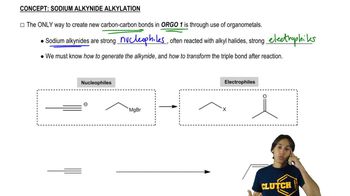
What is the main purpose of using sodium alkynides in organic synthesis?
Sodium alkynides are used to create new carbon-carbon bonds by acting as strong nucleophiles that react with alkyl halides.
Why are alkyl halides commonly paired with sodium alkynides in reactions?
Alkyl halides are strong electrophiles, making them suitable partners for the strong nucleophilic sodium alkynides to form carbon-carbon bonds.
What is the significance of forming new carbon-carbon bonds in organic synthesis?
Forming new carbon-carbon bonds is crucial for building larger molecules from smaller ones, which is a key aspect of synthesis.
What must you know about sodium alkynides besides their nucleophilicity?
You must know how to synthesize sodium alkynides, how to use them in reactions, and how to transform the resulting triple bond.
How can you generate a sodium alkynide from scratch?
A sodium alkynide is typically generated by deprotonating a terminal alkyne with a strong base such as sodium amide (NaNH2).
What does the presence of a triple bond in a molecule suggest about its synthetic history?
It suggests that a sodium alkynide may have been used to add carbons via alkylation.
If you start with a molecule containing three carbons and end with four, what likely occurred?
A carbon was added, likely through a reaction involving an organometal such as sodium alkynide.
What is the typical reaction partner for a sodium alkynide in alkylation?
The typical reaction partner is an alkyl halide.
After forming a new carbon-carbon bond with a sodium alkynide, what transformation might you need to perform?
You might need to convert the triple bond into a double bond or another functional group.
Why is it important to practice problems of increasing difficulty in alkynide alkylation?
Practicing problems of increasing difficulty helps build a deeper understanding of the synthetic process and problem-solving skills.
What is a key visual clue that sodium alkynide alkylation may have been used in a synthesis problem?
The presence of a triple bond and an increase in the carbon chain length are key clues.
What is the role of the negative charge on the carbon in sodium alkynide reactions?
The negative charge makes the carbon a strong nucleophile, allowing it to attack electrophilic carbons in alkyl halides.
What should you consider after using a sodium alkynide in a reaction?
You should consider how to further transform the triple bond to achieve the desired product.
What is the first step in solving a synthetic problem involving sodium alkynide alkylation?
Identify how many carbons need to be added and where the triple bond is located.
Why is understanding the mechanism of sodium alkynide alkylation important for synthesis?
Understanding the mechanism helps predict products and plan multi-step syntheses efficiently.
 BackBack


 03:19
03:19