Skip to main content
Organic Chemistry
My Course
Learn
Exam Prep
AI Tutor
Study Guides
Textbook Solutions
Flashcards
Explore
Try the app
My Course
Learn
Exam Prep
AI Tutor
Study Guides
Textbook Solutions
Flashcards
Explore
Try the app
Back
Alkynide Synthesis definitions
You can tap to flip the card.
Terminal Alkyne
You can tap to flip the card.
👆
Terminal Alkyne
A molecule featuring a carbon-carbon triple bond at the end of its chain, with a hydrogen directly attached to the terminal carbon.
Track progress
Control buttons has been changed to "navigation" mode.
1/13
Related flashcards
Related practice
Recommended videos
Alkynide Synthesis quiz #1
Alkynide Synthesis and Retrosynthesis
10 Terms
Alkynide Synthesis
9. Alkenes and Alkynes
7 problems
Topic
Johnny
POCl3 Dehydration
9. Alkenes and Alkynes
1 problem
Topic
Ernest
9. Alkenes and Alkynes - Part 1 of 2
5 topics
11 problems
Chapter
Ernest
9. Alkenes and Alkynes - Part 2 of 2
5 topics
11 problems
Chapter
Johnny
03:25
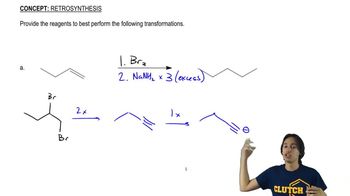
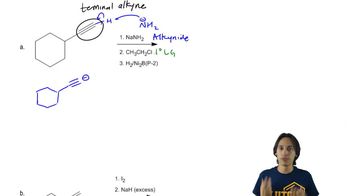
Predict the major product.
3498
views
19
rank
8
comments
04:17
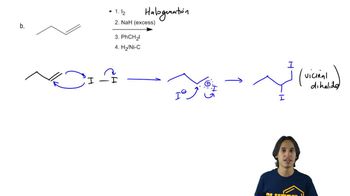
Provide the reagents needed
2453
views
17
rank
18
comments
05:09
Predict the major product.
3041
views
21
rank
18
comments
Terms in this set (13)
Hide definitions
Terminal Alkyne
A molecule featuring a carbon-carbon triple bond at the end of its chain, with a hydrogen directly attached to the terminal carbon.
Deprotonation
A process where a strong base removes a hydrogen atom, generating a negatively charged species from a molecule.
Acetylide Ion
A highly nucleophilic, negatively charged carbon species formed by removing a proton from a terminal alkyne.
Strong Base
A reagent, such as NH2-, capable of efficiently abstracting a proton from weakly acidic molecules like terminal alkynes.
Nucleophile
A species with a lone pair or negative charge that seeks out electron-deficient centers to form new bonds.
Leaving Group
An atom or group that departs with a pair of electrons during a substitution or elimination reaction, facilitating bond formation.
SN2 Mechanism
A one-step substitution process where a nucleophile attacks from the side opposite the leaving group, causing inversion of configuration.
Alkyl Halide
A compound containing a carbon chain bonded to a halogen, often serving as a substrate in nucleophilic substitution.
Backside Attack
A nucleophilic approach from the side opposite the leaving group, characteristic of SN2 reactions, leading to stereochemical inversion.
Lindlar’s Catalyst
A palladium-based reagent modified to selectively hydrogenate alkynes to cis-alkenes without further reduction.
Partial Hydrogenation
A reaction that adds hydrogen to a multiple bond, stopping at the alkene stage and not proceeding to full saturation.
Cis Double Bond
A configuration where substituents on a double bond are on the same side, often resulting from selective hydrogenation.
Multistep Synthesis
A sequence of chemical transformations designed to construct complex molecules from simpler starting materials.
 BackBack

 03:25
03:25