Back

Allylic Halogenation definitions

Control buttons has been changed to "navigation" mode.
1/15
  • Allylic Halogenation

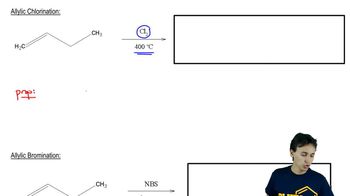
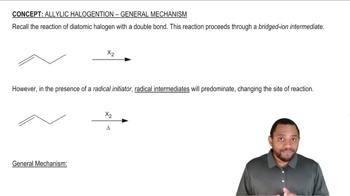
    A radical-based process replacing a hydrogen adjacent to a double bond with a halogen, yielding multiple products due to resonance.
  • Radical Initiator

    A substance like heat, UV light, or peroxides that triggers homolytic cleavage, generating radicals to start a chain reaction.
  • Allylic Position

    A carbon atom directly next to a double-bonded carbon, often targeted in selective halogenation reactions.
  • Initiation Step

    The phase where a diatomic halogen splits evenly, forming two radicals via homolytic cleavage.
  • Propagation Step

    The sequence where a radical reacts with a substrate, generating a new radical and continuing the chain reaction.
  • Termination Step

    The phase where two radicals combine, ending the chain reaction and forming the final product.
  • Homolytic Cleavage

    A bond-breaking event where each atom takes one electron, producing two radicals with unpaired electrons.
  • Resonance Structure

    An alternative electron arrangement in a molecule, explaining the distribution of radicals and multiple products.
  • Allylic Radical

    A species with an unpaired electron at the allylic position, stabilized by resonance across the π system.
  • N-Bromosuccinimide

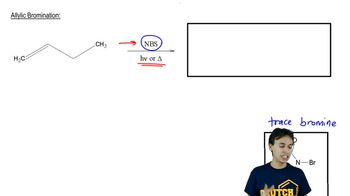
    A reagent providing trace bromine, favoring selective allylic bromination and minimizing unwanted addition.
  • Diatomic Halogen

    A molecule consisting of two identical halogen atoms, such as Cl2 or Br2, used as a halogen source.
  • Addition Product

    A compound formed when a halogen adds across a double bond, often minimized in allylic halogenation.
  • Vinylic Carbon

    A carbon atom directly involved in a double bond, distinct from the allylic position.
  • Mixture of Products

    The outcome of reactions yielding more than one compound, common in allylic halogenation due to resonance.
  • Anti Vicinal Dihalide

    A compound with two halogens on adjacent carbons, positioned on opposite sides, typical in traditional halogenation.